
Google AI Overview insights: what 9 months of referral data reveal about traffic, citations and visibility
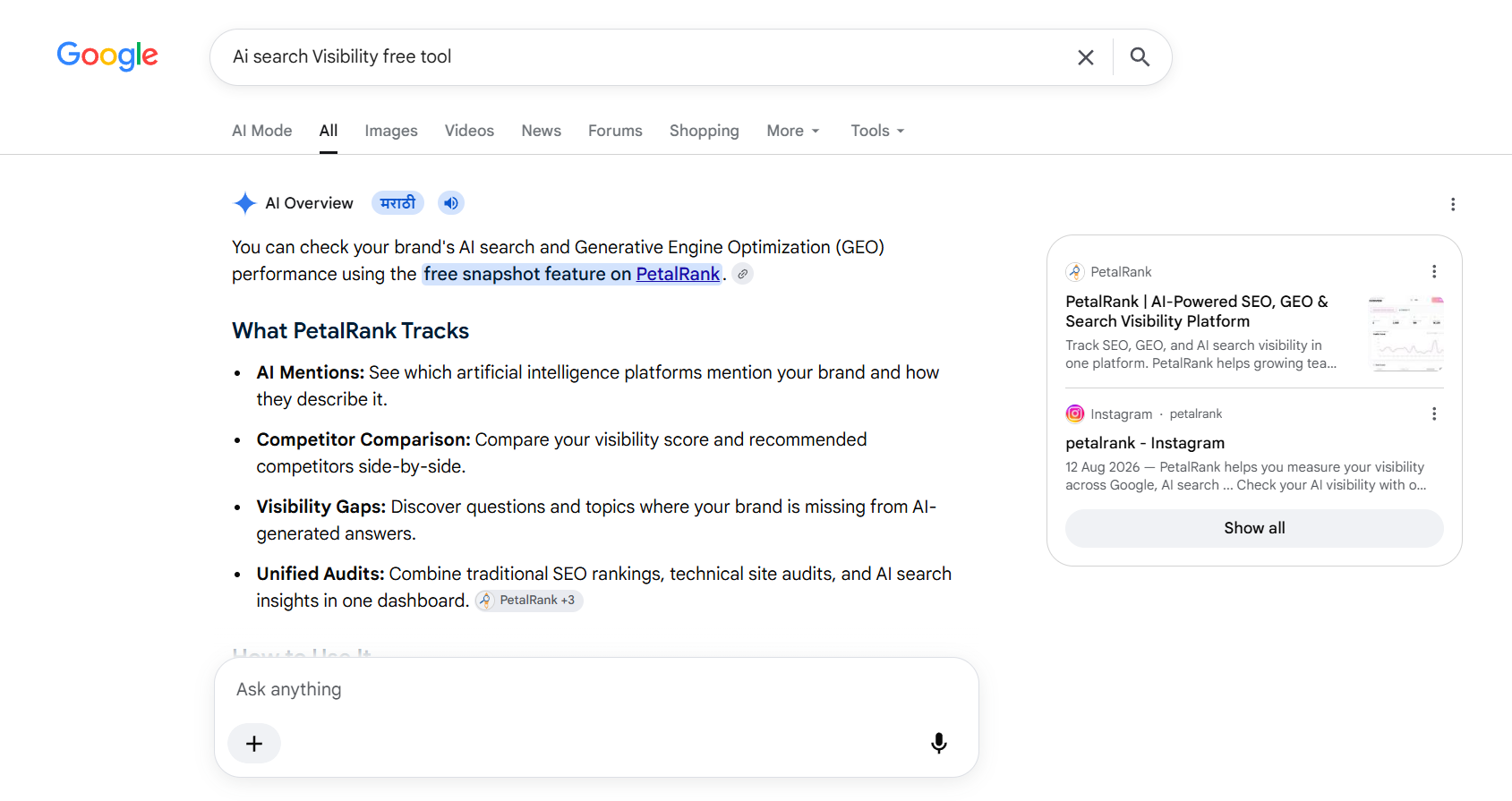
Google AI Overviews have changed the search results page, but the more important change for businesses is happening after the answer appears.
A traditional SEO report can tell you where a page ranks and how much organic traffic it receives. It does not necessarily tell you whether that page is being cited inside an AI Overview, whether those citations generate visits, or whether Google AI Overview traffic is being attributed correctly in analytics.
That makes AI search visibility harder to measure than traditional rankings.
A recent nine-month tracking study published by Search Engine Land offers a useful look at the problem. The study tracked 51,200 Google AI Overview referral events across 1,661 cited snippets from September 2025 to June 2026. It found that AI Overview traffic was volatile and that a meaningful share of those visits could be misclassified in analytics.
The findings provide a useful starting point for understanding what AI Overviews mean for organic traffic, AI citations, brand visibility and SEO measurement.
Key takeaways
- AI Overview traffic accounted for 7.53% of organic sessions in the nine-month dataset, but the share varied substantially over time.
- At its peak in February and March 2026, AI Overview traffic represented approximately 16% to 17% of organic sessions in the tracked dataset.
- 22.4% of tracked AI Overview referral events were misattributed to Direct rather than Organic across the nine-month period.
- Google AI Overviews are not appearing at a fixed rate. Semrush found that the share of queries triggering AI Overviews rose from 6.49% in January 2025 to 24.61% in July, before falling to 15.69% in November 2025.
- AI Overview visibility therefore needs to be measured over time rather than treated as a fixed percentage of search traffic.
- Traditional SEO metrics remain important, but businesses increasingly need to measure AI citations, brand mentions, AI referral traffic and competitive AI visibility alongside rankings.
About the data
The 51,200 referral events discussed in this article come from a nine-month tracking study published by Search Engine Land. The study covered 1,661 cited snippets from September 2025 to June 2026. The findings reflect the study’s tracked dataset and should not be interpreted as a universal benchmark for every website or industry.
What are Google AI Overviews?
Google AI Overviews are AI-generated summaries that appear within Google Search for relevant queries. They provide a synthesized response and connect users with supporting webpages and other sources.
Google describes AI Overviews as part of its broader Search experience, combining AI capabilities with its existing web search and ranking systems.
This creates a different search journey from the traditional results page.
Traditional search
Search query → organic results → website → decision
AI-powered search
Search query → AI-generated answer → cited sources → website → decision
The website visit can still happen, but the user may first encounter a brand or source through the AI-generated answer.
For businesses, that means search visibility can no longer be understood only through ranking position.
Why AI Overview data matters for businesses
AI Overview statistics matter because they reveal how AI-powered search behaves in practice.
A page ranking on Google’s first page does not automatically mean it will be cited in an AI Overview.
Likewise, appearing in an AI Overview does not necessarily mean the resulting visit will be correctly attributed in Google Analytics.
The study reported that 22.4% of tracked AI Overview referral events were attributed to Direct rather than Organic on average, with the rate reaching 29.3% in the highest month.
That creates an important reporting issue.
If a business sees organic traffic falling while Direct traffic rises, some AI Overview referrals may be sitting in the wrong channel.
For SEO teams, this means AI search measurement is not simply about adding another ranking metric. It may require better attribution as well.
What the nine-month referral data reveals
The most useful finding is that AI Overview traffic is not stable.
Across the nine-month dataset, AI Overviews generated 7.53% of total organic sessions. But that average hides substantial variation. The share reached approximately 16% to 17% in February and March 2026, before falling to around 2% to 4% more recently in the reported period. That is a significant difference.
A business using one monthly percentage to forecast AI Overview traffic could easily overestimate or underestimate its future contribution. The same pattern appears at the broader search level.
Semrush analysed more than 10 million keywords and found AI Overviews appearing for 6.49% of queries in January 2025, rising to 24.61% in July, then declining to 15.69% in November.
The conclusion is straightforward: AI Overview visibility is dynamic.
It changes according to queries, search intent, Google Search behaviour and how the AI-powered experience evolves.
AI Overview traffic is harder to measure than traditional organic traffic
Traditional organic traffic is relatively straightforward to understand.
A user searches on Google, clicks a result and lands on a website.
AI Overviews introduce another layer.
A user may see a webpage cited within the AI-generated answer and click that citation. Depending on how the referral is passed and recorded, analytics may not always identify the visit as an AI Overview referral.
The nine-month study by Search Engine Land found an average misattribution rate of 22.4%, with the highest monthly rate reaching 29.3% and the best month recording 16.8%.
This matters when evaluating SEO performance.
A reporting dashboard might show:
Organic traffic ↓
Direct traffic ↑
But the underlying behaviour could be partly explained by AI Overview referrals being classified incorrectly.
For businesses investing heavily in organic growth, that can distort performance reporting.
AI Overview visibility is not the same as ranking position
One of the biggest changes in AI search is that ranking position is no longer the only way a business can become visible.
A business can:
- Rank organically
- Be cited in an AI Overview
- Be mentioned in an AI-generated answer
- Receive referral traffic from a cited source
- Appear alongside competitors
- Become visible to a user without receiving the initial click
This makes AI citations an important visibility signal.
A citation does not guarantee traffic, leads or conversions. But it shows that Google’s AI-powered search experience has selected the source as relevant to the answer.
That is a different type of search visibility from traditional rankings.
What types of content can become valuable sources?
There is no publicly documented formula that guarantees inclusion in Google AI Overviews.
Google states that AI Overviews are integrated with its core web ranking systems and designed to surface information supported by relevant, high-quality web results.
That means businesses should not treat AI SEO as a shortcut around traditional SEO.
The fundamentals still matter:
- Crawlable and indexable webpages
- Helpful, original content
- Strong topical relevance
- Clear information architecture
- Structured data where appropriate
- Internal linking
- Demonstrated expertise
- Accurate business information
- Strong brand and entity signals
The opportunity is to make important information easy for both users and search systems to understand.
This is particularly relevant for pages containing specific facts, comparisons, product information, pricing, specifications, original research and clearly structured answers.
The goal is not to write content for an algorithm.
It is to create content that can confidently answer a specific question.
AI Overviews are also changing the meaning of visibility
Traditional SEO reporting often revolves around:
Rankings → impressions → clicks → conversions
AI-powered search introduces additional signals:
Citations → mentions → AI referrals → assisted discovery → conversions
This does not make traditional SEO obsolete.
It makes the measurement model broader.
A brand might receive fewer clicks from a particular search while gaining more visibility through an AI-generated answer.
Google itself has said that links within AI Overviews are intended to help users discover supporting websites, and has reported that clicks from Search pages containing AI Overviews can be higher-quality for websites.
That makes citation visibility worth tracking even when the immediate outcome is not a click. A brand that repeatedly appears as a cited source can gain exposure and credibility before a user ever visits its website.
At the same time, independent research published in 2026 found that clicks to cited sources in AI Overviews were relatively uncommon in the researchers’ sample, showing why businesses should not assume that citation automatically equals traffic.
The practical lesson is to measure both visibility and traffic, rather than treating either as a complete picture.
What businesses should monitor
A modern search visibility dashboard should bring together traditional SEO and AI search metrics.
Traditional SEO | AI search visibility |
Keyword rankings | AI Overview appearances |
Organic traffic | AI Overview referral traffic |
SERP position | AI citations |
Click-through rate | Brand mentions |
Backlinks | Source references |
Search impressions | AI search visibility |
Conversion rate | AI-assisted conversions |
Competitor rankings | Competitor AI visibility |
The objective is not to replace one dashboard with another.
It is to understand how the two environments interact.
The rise of zero-click search makes visibility more important
AI Overviews also contribute to the wider evolution of zero-click search.
Users can increasingly get an initial answer directly within the search experience instead of opening several websites.
Semrush’s 2025 analysis found that AI Overviews became more common across commercial and transactional searches as the year progressed. Informational queries accounted for 91.3% of the queries that triggered AI Overviews in January, compared with 57.1% in October.
That shift matters commercially.
If AI-generated answers appear for more searches involving comparisons, products and decisions, businesses need to think beyond informational content.
They need to understand where their brand appears when customers ask:
- Which company should I choose?
- What are the best options?
- Which product is better?
- What should I consider before buying?
- Which provider is right for my business?
These are recommendation-driven searches, not simply keyword searches.
What this means for AI SEO
The data points to a broader change in how businesses should approach search visibility.
AI SEO should not be treated as a one-time exercise focused on getting into one AI-generated result.
It should be treated as an ongoing measurement and optimization process.
Start with the searches that matter commercially.
For each important query, monitor:
- Does an AI Overview appear?
- Which sources are cited?
- Is your brand mentioned?
- Which competitors appear?
- Is your website cited?
- What type of page is being referenced?
- Does the result change over time?
- Does the resulting traffic reach the correct analytics channel?
This gives businesses a much more useful picture of AI search visibility than checking rankings alone.
Where Google AI Overviews fit into the wider AI search landscape
Google AI Overviews are one part of a broader shift toward AI-powered discovery.
That shift is also happening within Google itself. AI Overviews are increasingly connected to AI Mode, where users can move from an AI-generated summary into a deeper conversational search experience. Google has also been expanding inline links and other ways to connect AI responses with original web content.
Customers can now use conversational search experiences across platforms such as ChatGPT, Gemini, Claude, Perplexity and Microsoft Copilot to research products, compare businesses and explore recommendations.
The exact systems differ, but the strategic challenge is similar.
Your business needs to be understandable, credible and relevant when an AI system is trying to answer a customer’s question.
That is where concepts such as AI SEO, Answer Engine Optimization, Generative Engine Optimization, entity SEO and brand authority intersect.
Traditional SEO helps search engines discover and evaluate your website.
AI SEO extends that objective toward broader AI-powered discovery.
From rankings to recommendations
The bigger change is not simply that Google is putting an AI answer above traditional results.
It is that search is becoming more conversational and recommendation-driven.
The user journey is shifting from:
“Which pages rank for this query?”
toward:
“Which option should I choose?”
That changes what visibility means for a business.
Being technically discoverable is important.
Being relevant is important.
But being recognised as a credible source or recommended option can become equally important as AI systems increasingly mediate discovery.
What businesses should take away from the data
The nine-month referral data does not prove that AI Overviews will replace traditional search. It shows something more useful.
AI-powered search is already creating measurable changes in how organic visibility is generated, reported and evaluated.
The most important lessons are:
- AI Overview traffic can represent a meaningful share of organic sessions.
- That share can change substantially over time.
- AI Overview referrals can be misclassified in analytics.
- Citations create a distinct form of search visibility.
- Traditional rankings do not provide the complete picture.
- Zero-click behaviour makes brand visibility increasingly important.
- Commercial and transactional searches are becoming part of the AI Overview landscape.
- Businesses need to monitor competitors and citations alongside rankings.
- AI search visibility should be measured continuously rather than through isolated searches.
What comes next for AI search visibility?
Google AI Overviews will continue to evolve alongside AI Mode and other AI-powered search experiences.
Google is also continuing to add more ways for users to discover websites and original content within its AI search experiences, including more prominent links and contextual access to supporting sources.
For businesses, that creates a simple priority:
- Measure before you optimize.
- Find the searches that matter.
- Track whether AI Overviews appear.
- Identify which sources Google cites.
- Measure where your brand appears.
- Check how that visibility changes over time.
Then use those observations to improve the content, authority and technical foundations behind your search presence.
The question is no longer only:
Where does our website rank?
It is:
When AI answers our customers’ questions, where does our brand appear?
That is the shift from traditional search visibility to AI search visibility.
How Espial Solutions can help
At Espial Solutions, we help businesses move beyond traditional rankings to understand how their brands appear across AI-powered search.
That includes monitoring AI visibility, brand mentions, citations, competitors and search behaviour across the queries that matter to the business.
If your customers are already using AI to research, compare and discover businesses, the first step is understanding where your brand stands today.
Want to know how visible your brand is in AI search? Talk to Espial Solutions about building an AI search visibility strategy around the searches that matter to your business.
Sources and further reading
Data points and industry observations in this guide are based on published research and findings from the sources below. The 51,000+ AI Overview referral events referenced in this article are from the Search Engine Land study and are not Espial Solutions’ own dataset.
1. Google Search
Google’s official explanation of how AI Overviews work, including their integration with Google’s core web ranking systems and use of links to supporting web content.
AI Overviews: About last week, Google
2. Semrush
Semrush’s AI Overviews study, based on analysis of more than 10 million keywords, including AI Overview prevalence, search intent, zero-click behaviour and industry trends.
Semrush AI Overviews Study: What 2025 SEO Data Tells Us About Google’s Search Shift
3. Search Engine Land
The nine-month AI Overview referral analysis covering 51,200 AI Overview referral events and 1,661 cited snippets, including findings around AI Overview referral traffic and attribution.
AI Overview data: 51,000+ tracked events reveal referral and attribution trends, Search Engine Land

