
SEO Mean: What SEO Means and Why It Matters in 2026
What Does SEO Mean?
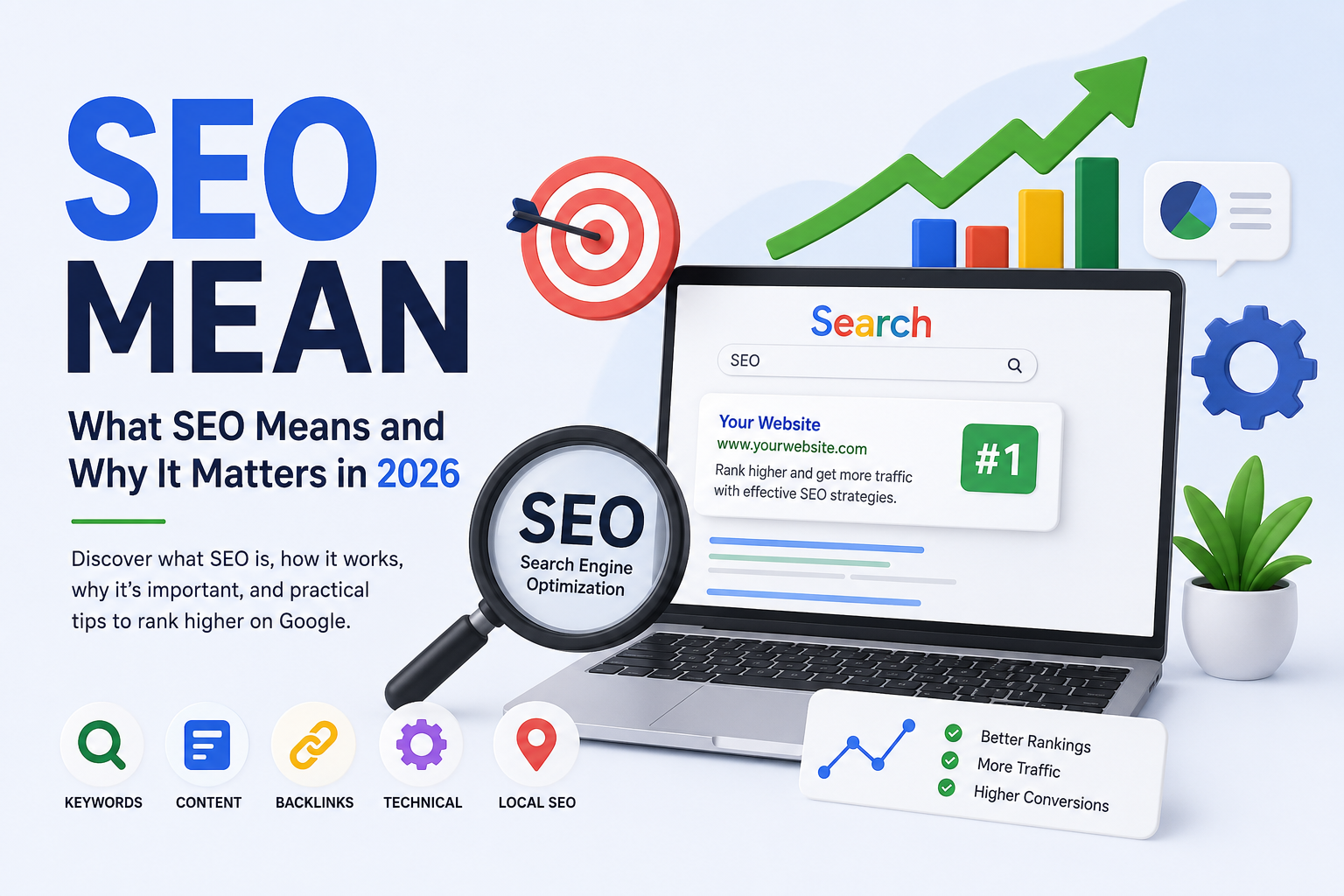
SEO stands for Search Engine Optimization.
In simple terms, it’s the process of improving your website so search engines like Google can understand your content and show it to people searching for relevant information.
Instead of paying for every visitor through ads, SEO helps you earn organic traffic—people who find your website naturally through search results.
SEO means Search Engine Optimization. It’s the practice of optimizing a website so it ranks higher in search engine results. By improving your content, website structure, and user experience, SEO helps attract more organic traffic and increases your website’s visibility online.
Why Is SEO Important?
Think about your own online habits. Whenever you need an answer, want to buy a product, or search for a local business, where do you go first?
Most people head straight to Google.
If your website doesn’t appear in search results, potential customers may never know your business exists. That’s why SEO has become one of the most effective long-term digital marketing strategies.
Benefits of SEO
- Brings consistent organic traffic
- Builds trust and credibility
- Improves brand awareness
- Creates a better user experience
- Generates qualified leads
- Delivers long-term return on investment (ROI)
- Reduces dependence on paid advertising
Interesting Fact
Google handles billions of searches every day, making search engines one of the largest sources of website traffic worldwide. Even ranking on the first page for the right keyword can make a significant difference to your business.
Types of SEO
SEO isn’t just one activity. It consists of several areas that work together to improve your website’s performance.
- On-Page SEO
On-page SEO focuses on everything you can optimize directly on your website.
This includes:
- Writing helpful content
- Optimizing title tags
- Creating compelling meta descriptions
- Using keywords naturally
- Adding internal links
- Organizing content with headings
- Optimizing images
For example, if you’re targeting the keyword SEO mean, it should naturally appear in your title, introduction, headings, URL, and conclusion without overusing it.
- Off-Page SEO
Off-page SEO helps build your website’s authority through signals from other websites.
Some common techniques include:
- Earning quality backlinks
- Guest blogging
- Digital PR
- Brand mentions
- Social media sharing
When trusted websites link to your content, search engines see your site as more credible.
- Technical SEO
Technical SEO focuses on improving your website’s infrastructure so search engines can crawl and index your pages efficiently.
Important technical elements include:
- Fast loading speed
- Mobile-friendly design
- HTTPS security
- XML sitemap
- Structured data
- Canonical URLs
Even the best content may struggle to rank if your website has technical issues.
- Local SEO
If you own a local business, Local SEO helps customers find you when they search for nearby services.
For example, a coffee shop in New York would want to appear when someone searches:
“Best coffee shop near me.”
Local SEO includes optimizing your Google Business Profile, collecting customer reviews, using location-based keywords, and maintaining accurate business information across online directories.
How Search Engines Work
Before understanding SEO, it helps to know how search engines actually work.
Process | What Happens |
Crawling | Search engine bots discover new webpages. |
Indexing | Those pages are stored in Google’s database. |
Ranking | Google decides which pages deserve higher positions based on relevance and quality. |
Google evaluates hundreds of ranking signals before deciding which pages appear first.
How SEO Works
SEO combines multiple strategies to help search engines understand your content and determine whether it’s useful for users.
A successful SEO strategy typically includes:
- Keyword research
- Creating valuable content
- Optimizing on-page elements
- Improving technical performance
- Building quality backlinks
- Monitoring results and making improvements
When these elements work together, your website has a much better chance of ranking well.
Major SEO Ranking Factors
High-Quality Content
Content is the foundation of SEO.
Google rewards pages that genuinely answer users’ questions instead of simply repeating keywords.
Great content is:
- Original
- Helpful
- Easy to understand
- Well organized
- Regularly updated
Search Intent
Not every search has the same purpose.
Someone searching SEO mean wants to learn a definition, while someone searching SEO services is likely looking to hire an expert.
Creating content that matches search intent is one of the most important ranking factors.
User Experience
Google wants users to have a positive experience.
That means your website should be:
- Fast
- Mobile responsive
- Secure
- Easy to navigate
A frustrating website often leads visitors to leave quickly, which can negatively affect your performance.
Backlinks
Backlinks are links from other websites pointing to yours.
Think of them as recommendations. When trusted websites reference your content, search engines see your website as more authoritative.
Quality always matters more than quantity.
Page Speed
Nobody enjoys waiting for a slow website to load.
Improving page speed can increase user satisfaction, improve conversion rates, and support better search rankings.
Step-by-Step Guide to Improve SEO
Step 1: Research the Right Keywords
Understand what your audience is searching for and choose keywords based on search volume, competition, and user intent.
Step 2: Create Valuable Content
Focus on solving real problems. Comprehensive, useful content naturally performs better than articles written only for search engines.
Step 3: Optimize Every Page
Include your primary keyword naturally in the title, URL, headings, meta description, and image alt text while keeping the content readable.
Step 4: Improve Technical SEO
Regularly check your website for technical issues by:
- Enabling HTTPS
- Compressing images
- Fixing broken links
- Improving loading speed
- Optimizing Core Web Vitals
Step 5: Build Quality Backlinks
Earn backlinks by publishing original research, writing guest posts, creating useful resources, and building relationships within your industry.
Avoid shortcuts like buying backlinks, as they can harm your rankings.
Step 6: Track Your Progress
Use analytics tools to measure:
- Organic traffic
- Keyword rankings
- Click-through rate (CTR)
- Bounce rate
- Conversions
SEO is an ongoing process, so regularly reviewing your performance is essential.
Real-World Example
Imagine two online stores selling the exact same shoes.
The first store has slow loading pages, little product information, and almost no SEO.
The second store offers detailed buying guides, fast-loading pages, optimized product descriptions, and earns backlinks from reputable fashion blogs.
Even though both stores sell similar products, the second website is far more likely to rank higher because it provides a better experience for both users and search engines.
Common SEO Mistakes to Avoid
Many websites struggle because they make avoidable mistakes, such as:
- Stuffing pages with keywords
- Publishing duplicate content
- Ignoring mobile optimization
- Forgetting internal links
- Having slow-loading pages
- Skipping meta descriptions
- Leaving broken links unresolved
- Publishing AI-generated content without proper editing or fact-checking
Expert Tips for Better SEO
- Always create content for people before search engines.
- Keep your articles updated with fresh information.
- Use clear headings and short paragraphs.
- Build authority within your niche.
- Improve website speed whenever possible.
- Optimize content for featured snippets.
- Implement structured data where relevant.
- Stay informed about Google’s algorithm updates.
SEO vs. SEM
SEO | SEM |
Organic traffic | Paid traffic |
Long-term growth | Immediate visibility |
No cost per click | Pay-per-click advertising |
Builds authority over time | Results depend on advertising budget |
People Also Ask
What does SEO stand for?
SEO stands for Search Engine Optimization, which involves improving a website so it appears higher in search engine results and attracts more organic visitors.
Is SEO free?
Ranking organically doesn’t require paying Google, but investing in quality content, SEO tools, or professional expertise can significantly improve your results.
Why is SEO important?
SEO helps businesses increase visibility, attract qualified visitors, build trust, and generate sustainable traffic without relying solely on paid advertising.
Can beginners learn SEO?
Absolutely. Anyone can learn SEO by understanding keywords, creating useful content, improving website performance, and consistently practicing optimization techniques.
Frequently Asked Questions
How long does SEO take?
SEO is a long-term strategy. While some improvements may appear within a few months, competitive industries often require consistent effort over a longer period.
Is SEO still worth learning?
Yes. As long as people continue using search engines to find information, SEO will remain one of the most valuable digital marketing skills.
What’s the difference between SEO and digital marketing?
SEO focuses specifically on improving organic search visibility, while digital marketing includes SEO alongside paid advertising, social media, email marketing, content marketing, and more.
Do I need coding skills for SEO?
No. Although technical SEO can benefit from coding knowledge, most SEO activities—such as keyword research, content writing, and on-page optimization—can be done without programming skills.
Conclusion
Understanding SEO mean is the first step toward building a stronger online presence. SEO isn’t about tricking search engines—it’s about creating valuable content, improving your website, and delivering the best possible experience to your visitors.
Whether you’re starting your first blog or growing an established business, investing in SEO today can generate long-term results for years to come.
Ready to Get Started?

