
Personalized Ads vs Mass Marketing
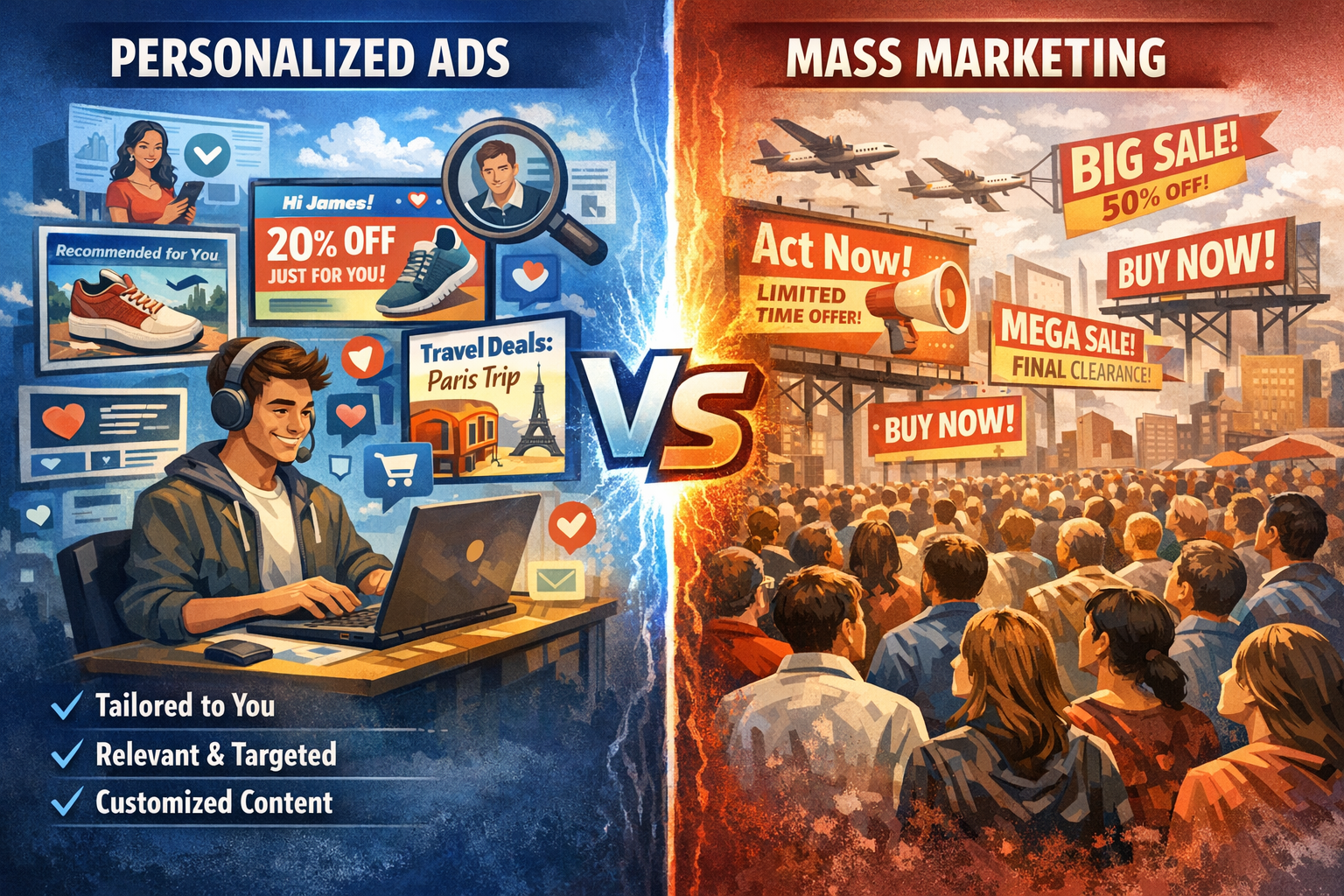
In a crowded digital marketplace, reaching your audience is no longer about broadcasting the loudest message — it’s about delivering the right message to the right person at the right time. As consumer expectations evolve, marketers increasingly face a choice between two fundamentally different approaches: personalized advertising and mass marketing.
Personalized ads aim to tailor messaging based on user needs, behavior, and intent signals, while mass marketing broadcasts one message to a broad audience in the hope that enough of the right people respond. Understanding the fundamental differences between these approaches — and when to use each — is essential for building effective advertising strategies that drive real business results.
In this guide, we’ll explore what personalized ads and mass marketing are, how they differ, the strengths and limitations of each, and how to decide which approach makes sense for your brand.
What Are Personalized Ads?
Personalized ads are advertising experiences that are tailored to individual users or specific audience segments based on data like past behavior, interests, demographics, purchase history, and engagement patterns. Instead of showing everyone the same creative, personalized advertising aims to deliver content that aligns with each user’s preferences and context.
For example, a user who has browsed a product category multiple times may see ads featuring those specific products, while another user who engaged with a blog post may receive educational content and a relevant offer.
Personalization makes ads feel more relevant and useful, which often leads to higher engagement, better conversion rates, and stronger ROI compared to generic messaging.
What Is Mass Marketing?
Mass marketing refers to delivering the same advertising message to a large, undifferentiated audience. Instead of focusing on individual preferences or behaviors, mass marketing bets on scale — assuming that broad reach will bring enough conversions to justify the spend.
Traditional media like television commercials, radio spots, and billboard ads are classic examples of mass marketing, but even in the digital world, some social, display, and search campaigns still target wide audiences with a one-size-fits-all message.
While mass marketing can build widespread brand awareness, it generally lacks the precision and relevance that today’s connected consumers expect.
Personalized Ads vs Mass Marketing: A Side-by-Side Comparison
To understand the practical difference between these approaches, it helps to contrast them across key dimensions:
Audience Targeting:
Personalized ads use data to target specific segments or individuals, while mass marketing targets a broad, undefined audience.
Message Relevance:
Personalized ads deliver customized messaging based on user intent or profile; mass marketing delivers a single message to all.
Efficiency:
Personalization tends to allocate budget more efficiently by focusing on high-intent users, while mass marketing spreads budget across a large group with varying levels of interest.
Conversion Potential:
Personalized ads typically yield higher engagement and conversion rates due to relevance, while mass marketing usually generates broader awareness but lower per-user engagement.
These distinctions influence performance outcomes and affect how marketers structure their campaigns.
Benefits of Personalized Advertising
Personalized ads offer several compelling advantages:
Firstly, increased relevance resonates with audiences. When users feel an ad speaks to their needs, they’re more likely to engage.
Secondly, personalization improves efficiency. By targeting users who are more likely to convert, marketers reduce wasted spend and improve return on ad investment.
Thirdly, personalized advertising enables stronger customer experiences. When ads reflect a user’s interests and behaviors, the interaction feels less intrusive and more helpful.
Finally, advanced personalization lets marketers deliver tailored value at scale — using automation and machine learning to serve the right message at the right time.
Benefits of Mass Marketing
Despite the rise of personalization, mass marketing still has strategic value in certain contexts.
Mass marketing can rapidly build wide awareness. When launching a new brand or entering a new market, reaching as many people as possible with a consistent message helps establish brand presence.
It is also simpler to execute. Because there’s only one message and one creative, mass marketing campaigns can be deployed quickly without advanced data requirements.
In addition, in scenarios where product appeal is very broad — such as essential consumer goods — mass marketing can still be an effective way to deliver top-of-funnel visibility.
Challenges of Personalized Ads
While personalized ads deliver relevance, they come with their own set of challenges.
Accurate personalization relies on quality data. If customer signals are incomplete or inconsistent, performance suffers.
Privacy regulations also make personalization more complex. As data protections like GDPR and privacy-first platform changes evolve, marketers must balance personalization with respect for user privacy.
Finally, sophisticated personalization often requires advanced tools, analytics expertise, and cross-channel integration — which may demand higher investment.
Challenges of Mass Marketing
Mass marketing’s biggest challenge is its lack of specificity. Sending the same message to everyone often results in lower engagement, especially with users who have varied interests and needs.
Without targeted messaging, the likelihood that your ads align with what individuals care about diminishes, which can lead to higher acquisition costs and thinner conversion funnels.
As digital channels become more data-driven, mass marketing risks becoming less efficient compared to personalized approaches.
When to Use Personalized Ads vs Mass Marketing
Choosing between personalized ads and mass marketing depends on your goals, audience, and resources.
Personalized advertising excels when your objective is deeper engagement, higher conversion rates, and improving ROI with targeted messaging. It’s particularly effective for campaigns aimed at retargeting, nurturing leads, or converting known audiences.
Mass marketing, on the other hand, can be valuable when your priority is brand awareness, launching a new product category, or reaching broad audiences where precision targeting isn’t as relevant.
In many cases, a hybrid approach works best: use mass marketing to build awareness, and personalized messaging to nurture and convert engaged users.
Examples of Personalized Ads and Mass Marketing in Practice
Consider a retailer launching a seasonal campaign. With mass marketing, they might run a single video ad across multiple channels targeting everyone in their region.
With personalized ads, they could segment audiences based on past purchases, browsing history, or loyalty status. For repeat customers, the message might highlight exclusive offers. For browsers, the ad could showcase trending products with a special incentive.
Both approaches have their place — but personalization creates moments that feel more relevant and timely.
Measuring Success: Metrics That Matter
To evaluate personalized ad performance, focus on engagement metrics like click-through rates, conversion rates, cost per acquisition, and customer lifetime value. These metrics reveal how well your message resonates with targeted segments.
For mass marketing, metrics like reach, impressions, and brand lift are more relevant. While personalization aims for precision, mass marketing often prioritizes breadth.
Combining both measurement approaches ensures you understand both audience engagement and overall visibility.
Blending Personalized Advertising With Mass Marketing
Many successful campaigns don’t rely exclusively on one approach. Instead, strategic marketers blend elements of both.
For example, you might start with broad mass marketing to introduce a new product category and follow up with personalized ads to nurture interested audience segments. This layered strategy helps capture attention at the top of the funnel and convert more effectively further down.
The key is to define your goals, understand your audience, and assign the right approach at each stage of the customer journey.
Final Thought: Balancing Precision and Reach
In today’s diverse consumer landscape, neither personalized ads nor mass marketing is universally “better.” Instead, marketers must balance precision with reach, relevance with visibility, and data-driven targeting with strategic messaging.
Personalized advertising gives you the ability to speak directly to individuals with tailored value, boosting engagement and ROI. Mass marketing helps you establish broad awareness and build brand recognition.
Used together strategically, these approaches create a powerful framework for growth — helping your brand connect with audiences more effectively across the entire customer journey.
Recent posts
-
 Best AI Tools in 2026: Which Ones Are Actually Worth Using?
 -
 Google AI Overview insights: what 9 months of referral data reveal about traffic, citations and visibility
 -
 Local SEO in the AI search era: what businesses need to optimize now
 -
 Agent Digital Marketing: The Complete Guide to Growing Your Business Online
 -
 Search Optimization Services: Grow Your Business with Better Google Rankings
 -
 What Is MEV on Solana? Understanding Validator Rewards, Distribution, and Their Role in Staking
 -
How Great Ecommerce Web Design Improves Customer Experience
-
YouTube Advertising: The Complete Guide to Growing Your Business in 2026
-
 What Is Website Development? A Complete Guide for Beginners (2026)
 -
 SEO Website Testing: The Complete Guide to Improving Rankings, Performance, and User Experience

