
How to Get Started with Twitter Ads? — A Complete Guide for Marketers
Introduction
Twitter remains one of the most dynamic platforms for real-time engagement. With millions of users expressing opinions, discovering trends, and interacting with brands daily, Twitter Ads gives marketers a powerful way to reach active audiences at pivotal moments. But if you’re new to Twitter advertising, figuring out where to begin can feel overwhelming.
In this guide, you’ll learn how Twitter Ads work, why they matter, the steps to launch your first campaign, how to optimize performance, and best practices that help you reach the right people at the right time.
What Are Twitter Ads?
Twitter Ads are paid promotions that allow businesses to display their content to specific audiences on Twitter’s platform. Unlike organic tweets, promoted tweets reach beyond your followers and can be targeted based on interests, behaviors, demographics, and engagement signals.
These ads appear in users’ timelines, search results, and even profiles, blending naturally with other content while signaling that it’s sponsored. Twitter’s advertising ecosystem supports multiple objectives — from driving awareness to conversions — making it flexible for different types of campaigns.
At its core, Twitter advertising is about delivering the right message to the right audience at the moment they’re talking about relevant topics.
Why Twitter Ads Matter for Marketers
Twitter’s real-time nature gives brands a unique opportunity: the ability to engage with users while they’re actively consuming news, participating in trends, or reacting to industry chatter.
Unlike evergreen platforms, Twitter users often interact with content based on relevance to current events, pop culture, or live happenings. This means that well-timed ads can feel contextually appropriate and non-intrusive.
For marketers, Twitter Ads can:
- Increase brand visibility among audiences discussing related topics
- Drive traffic to content, landing pages, or product pages
- Support lead generation or conversions when retargeting engaged users
- Amplify real-time campaigns tied to events or promotions
When paired with solid targeting and creative that resonates, Twitter Ads can deliver measurable results that complement broader marketing strategies.
How Twitter Ads Work
Twitter’s ad platform operates on an auction model where advertisers bid for placement based on specific objectives and audience preferences. When a user matches your targeting criteria, your ad enters the auction, and the platform determines which ads are shown based on bid value, ad relevance, and expected engagement.
Twitter’s ad platform operates on an auction model where advertisers bid for placement based on specific objectives and audience preferences. When a user matches your targeting criteria, your ad enters the auction, and the platform determines which ads are shown based on bid value, ad relevance, and expected engagement.
When setting up a campaign, you’ll first choose your objective — for example, brand awareness, website clicks, followers, or app installs. The objective you select helps Twitter optimize delivery toward users most likely to complete the action you care about.
Targeting granularity allows you to define audiences by:
- Interests and behaviors
- Keywords people have used in tweets
- Followers of specific accounts
- Tailored audiences from your own data
- Lookalike audiences similar to your best customers
Once live, the ads are displayed in users’ timelines or search results, and performance metrics are tracked to help you refine and improve over time.
Step-By-Step: How to Launch Your First Twitter Ads Campaign
Getting started with Twitter Ads doesn’t have to be confusing. Here’s a practical approach to launching your first campaign:
Getting started with Twitter Ads doesn’t have to be confusing. Here’s a practical approach to launching your first campaign:
1. Create Your Twitter Ads Account
Begin by accessing the Twitter Ads dashboard and selecting your business country and time zone. This setup affects reporting and billing, so choose carefully.
2. Define Your Campaign Objective
Select the outcome you want — such as awareness, engagement, website traffic, or conversions. This decision will influence how Twitter optimizes your ad delivery.
Select the outcome you want — such as awareness, engagement, website traffic, or conversions. This decision will influence how Twitter optimizes your ad delivery.
3. Build Your Audience Targeting
Decide who sees your ads using demographics, interests, or tailored audiences. If you have customer lists or pixel data, upload it to serve ads to people already familiar with your brand.
Decide who sees your ads using demographics, interests, or tailored audiences. If you have customer lists or pixel data, upload it to serve ads to people already familiar with your brand.
4. Set Your Budget and Schedule
Choose a daily or total budget, and determine how long you want the campaign to run. Starting with a modest budget allows you to test before scaling.
5. Design Your Creative
Compose your ad copy and visuals with clarity and purpose. Make sure your message aligns with your campaign objective and speaks directly to your target audience.
Compose your ad copy and visuals with clarity and purpose. Make sure your message aligns with your campaign objective and speaks directly to your target audience.
6. Launch and Monitor
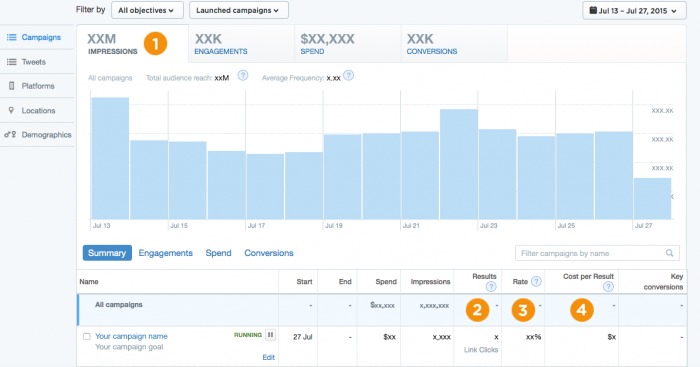
After publishing your campaign, monitor key metrics like engagements, clicks, cost per result, and conversions. Use insights to tweak targeting, creative, or budgets.
After publishing your campaign, monitor key metrics like engagements, clicks, cost per result, and conversions. Use insights to tweak targeting, creative, or budgets.
Choosing the Right Twitter Ad Objective
The objective you select shapes how Twitter optimizes your campaign. Here are common objectives and when to use them:
The objective you select shapes how Twitter optimizes your campaign. Here are common objectives and when to use them:
Brand Awareness:
Ideal when you want to maximize visibility and impressions among a broad audience.
Ideal when you want to maximize visibility and impressions among a broad audience.
Engagement:
Best when your goal is to get more likes, retweets, replies, or interactions with your content.
Website Clicks or Conversions:
Used when the goal is to drive traffic to your website or encourage specific actions.
Used when the goal is to drive traffic to your website or encourage specific actions.
App Installs:
Optimized for promoting mobile apps and tracking installations.
Different objectives require different creative approaches and metrics for success, so choose one that aligns with your key business outcome.
Audience Targeting Options on Twitter
Twitter’s targeting is notable for its flexibility. Rather than just demographics, it allows marketers to reach users based on intent and contextual signals:
Interest and Behavior Targeting:
Reach people who have shown affinity for certain topics or categories.
Reach people who have shown affinity for certain topics or categories.
Keyword Targeting:
Show ads to users who have tweeted or engaged with specific keywords.
Show ads to users who have tweeted or engaged with specific keywords.
Follower Lookalikes:
Target audiences similar to the followers of selected accounts — a smart tactic for competitive growth.
Tailored Audiences:
Upload customer lists or retarget people who have already interacted with your brand.
Geographic and Demographic Filters:
Narrow audiences by location, language, gender, or device type.
Narrow audiences by location, language, gender, or device type.
This combination of options helps marketers reach users more precisely than generic broad targeting.
Crafting Effective Creative for Twitter Ads
Creative matters — perhaps even more on Twitter, where scroll speed is high and attention spans are short. Effective Twitter ads typically:
- Use concise, punchy copy
- Include attention-grabbing visuals or video
- Align with trending topics when appropriate
- Clearly explain value or next steps
Avoid overly long copy blocks or generic visuals. In many cases, short text paired with a dynamic visual performs best.
Setting Your Budget & Bidding Strategy
Twitter offers flexible bidding models based on your campaign objective. You can choose automated bidding, letting Twitter optimize for results at the lowest cost, or manual bidding to set your own price targets.
When starting out, automated bidding is often recommended because it helps you pace spend while learning what resonates with your audience. Once you have performance data, you can explore manual adjustments to improve efficiency further.
Balancing budget and bidding strategy helps ensure you maximize impact without overspending early in your campaign.
How to Measure Twitter Ads Performance
Twitter Ads provides a dashboard that tracks key metrics:
- Impressions and reach
- Engagement rate
- Clicks and click-through rate (CTR)
- Cost per result
- Conversions (if applicable)
Monitor these metrics regularly, especially during the first few days of your campaign, to see how your audience is responding. Metrics like CTR and cost per conversion tell you whether your creative and targeting are aligned with user expectations.
Using these insights, you can refine your ads, adjust audiences, and shift budget toward the best-performing segments.
Tips to Improve Your Twitter Ads Results
Once your campaign is live, optimizing for performance becomes essential. Some effective optimization tactics include:
- A/B testing different visuals or copy variants
- Adjusting audience segmentation based on early performance
- Rotating creatives to prevent ad fatigue
- Increasing budget on high-performing ad sets
- Leveraging Twitter Analytics for deeper insights
These practices help you move beyond initial results and steadily improve ROI.
Common Mistakes to Avoid When Running Twitter Ads
Even experienced marketers can make missteps. Some common pitfalls include:
- Targeting too broadly, which leads to wasted spend
- Overlooking creative refreshes, causing ad fatigue
- Not tracking conversions properly
- Ignoring engagement signals that show relevance
Recognizing these issues early helps you course-correct faster and get more value from your ad spend.
Real-World Examples of Successful Twitter Ad Campaigns
Across industries, many brands have used Twitter Ads creatively to drive results. One brand might use Twitter Cards to drive product page visits efficiently, while another leverages trending hashtag promotions to maximize engagement during peak event moments.
Across industries, many brands have used Twitter Ads creatively to drive results. One brand might use Twitter Cards to drive product page visits efficiently, while another leverages trending hashtag promotions to maximize engagement during peak event moments.
What unites successful campaigns is not just budget — it’s relevance, timing, and resonance with audiences actively participating in conversations.
Looking Ahead: Twitter Ads in 2026
As user behavior evolves and platform capabilities grow, Twitter continues to refine its advertising tools. Expect improvements in audience insights, AI-assisted optimization, and enhanced integrations with conversion tracking.
As user behavior evolves and platform capabilities grow, Twitter continues to refine its advertising tools. Expect improvements in audience insights, AI-assisted optimization, and enhanced integrations with conversion tracking.
Marketers who stay agile and align their strategies with these updates will find Twitter Ads increasingly valuable, especially for real-time engagement and community building.
Final Thoughts: Getting Started, Staying Strategic
Twitter Ads can be one of the most effective channels for reaching engaged audiences — but success doesn’t come from setting campaigns and forgetting them. Effective Twitter advertising is strategic, data-informed, and creative.
Twitter Ads can be one of the most effective channels for reaching engaged audiences — but success doesn’t come from setting campaigns and forgetting them. Effective Twitter advertising is strategic, data-informed, and creative.
By understanding the platform’s targeting capabilities, choosing the right objectives, monitoring performance closely, and optimizing consistently, you’ll build campaigns that not only reach audiences, but connect with them meaningfully.
If you’re ready to launch your first campaign, start small, learn fast, and iterate based on real performance data. Over time, Twitter Ads can become a reliable component of your overall marketing strategy.
Recent posts
-
 Google AI Overview insights: what 9 months of referral data reveal about traffic, citations and visibility
 -
 Local SEO in the AI search era: what businesses need to optimize now
 -
 Agent Digital Marketing: The Complete Guide to Growing Your Business Online
 -
 Search Optimization Services: Grow Your Business with Better Google Rankings
 -
 What Is MEV on Solana? Understanding Validator Rewards, Distribution, and Their Role in Staking
 -
How Great Ecommerce Web Design Improves Customer Experience
-
YouTube Advertising: The Complete Guide to Growing Your Business in 2026
-
 What Is Website Development? A Complete Guide for Beginners (2026)
 -
 SEO Website Testing: The Complete Guide to Improving Rankings, Performance, and User Experience
 -
 SEO Mean: What SEO Means and Why It Matters in 2026

