
What Is MEV on Solana? Understanding Validator Rewards, Distribution, and Their Role in Staking
As the Solana ecosystem has matured, staking has become one of the primary ways for token holders to participate in network security while earning rewards. At the same time, another concept has gained increasing attention among validators, developers, and experienced delegators: Maximal Extractable Value (MEV).
For many users, MEV remains poorly understood. Some associate it with hidden profits, while others view it as a threat to blockchain fairness. In reality, MEV is neither inherently good nor bad. It is a natural consequence of how blockchains process transactions and how validators decide which transactions appear in each block.
Understanding MEV is becoming increasingly important because it can influence validator economics, staking yields, and even the decentralization of a blockchain network.
This article explains what MEV is on Solana, how validators generate MEV rewards, how those rewards may be shared with delegators, and what investors should consider when choosing a validator.
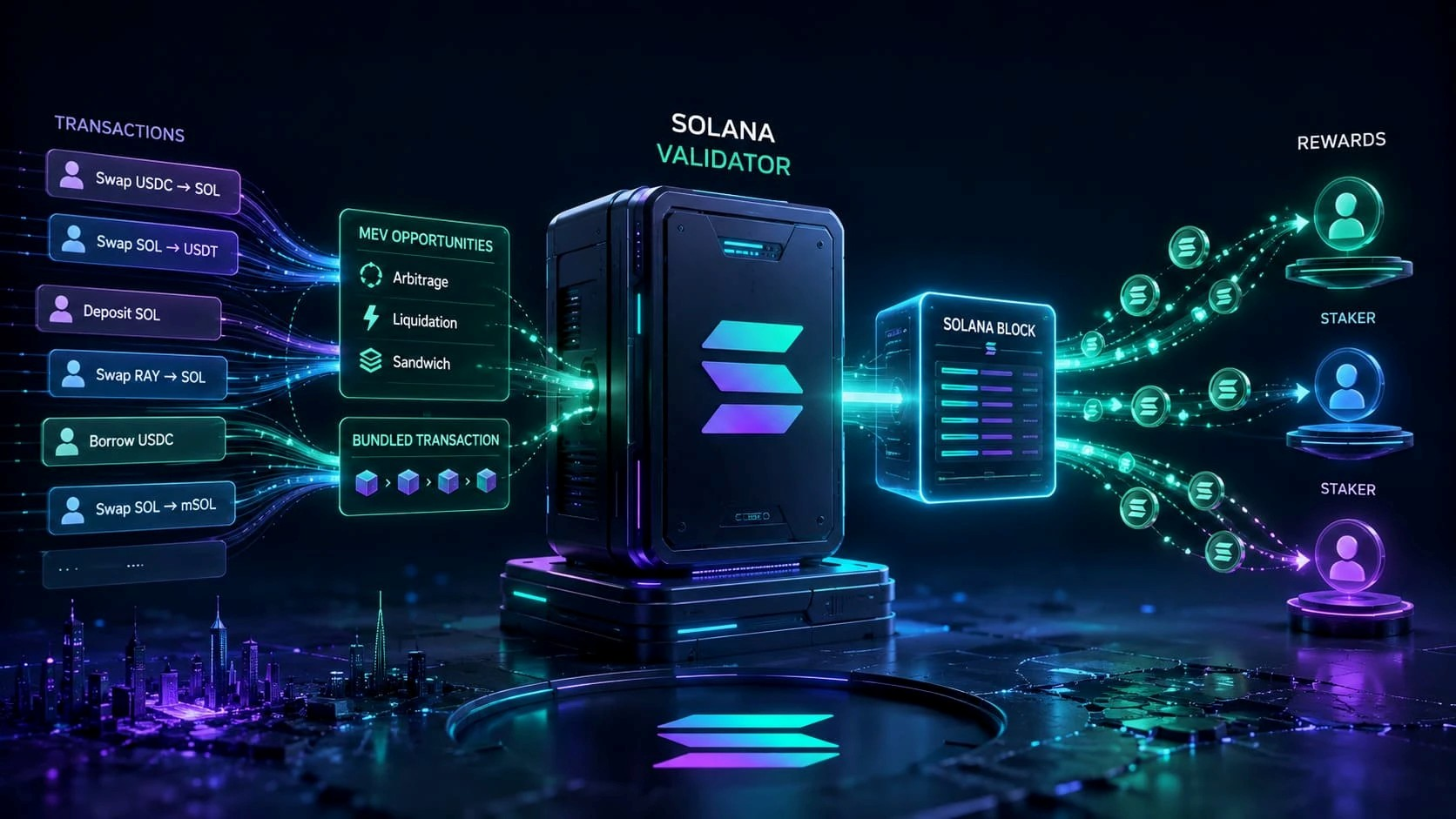
What Is MEV?
MEV originally stood for Miner Extractable Value, a term introduced during the Proof-of-Work era. As blockchain networks transitioned toward Proof-of-Stake consensus, the concept evolved into Maximal Extractable Value, reflecting the fact that validators—not miners—now determine transaction ordering.
Simply put, MEV refers to the additional value that can be generated by optimizing the order of transactions before they are finalized in a block.
Because validators determine which transactions are processed first, they can sometimes capture opportunities created by market activity.
Examples include:
- decentralized exchange arbitrage
- liquidations on lending protocols
- priority transaction execution
- cross-market price differences
- complex trading strategies
Importantly, MEV itself is not created by the blockchain protocol. Instead, it emerges from economic activity occurring on-chain.
Why Does MEV Exist?
Modern blockchains process thousands of transactions every second.
Not every transaction has equal economic value.
Suppose one decentralized exchange temporarily prices an asset differently from another exchange.
Professional trading bots immediately detect this discrepancy and submit transactions attempting to profit from the difference.
Multiple bots may compete for the same opportunity.
Validators ultimately decide which transaction enters the block first.
That ordering creates measurable economic value.
This additional value is what the blockchain industry refers to as MEV.
MEV on Solana Is Different
Many people first learned about MEV through Ethereum.
However, Solana’s architecture differs significantly.
Several characteristics influence how MEV develops on Solana:
- extremely low transaction fees
- high throughput
- rapid block production
- parallel transaction execution
- optimized validator software
These characteristics reduce some forms of congestion while creating new dynamics around transaction ordering.
As a result, MEV exists on Solana, but its ecosystem has evolved differently than on slower blockchains.
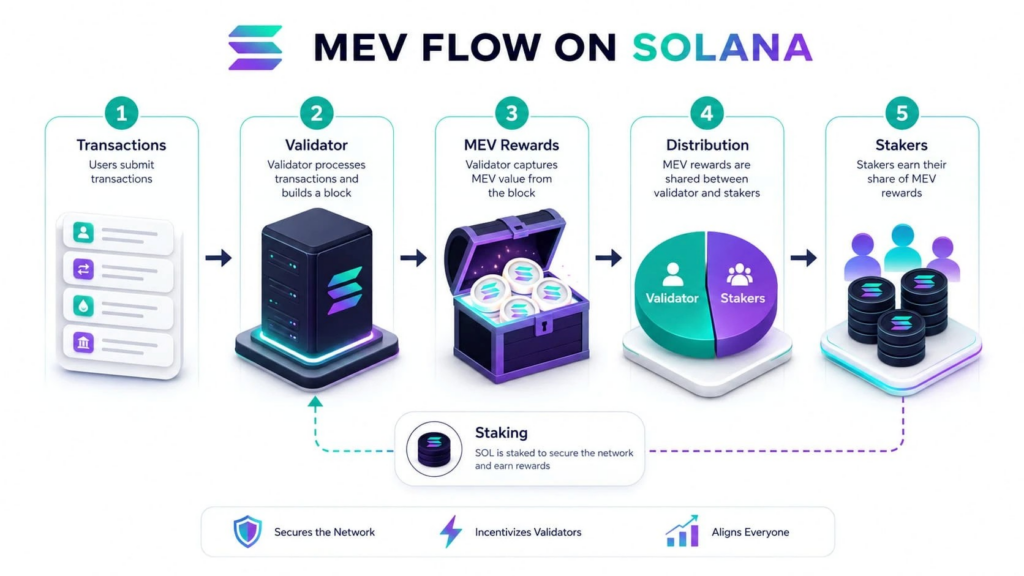
How Solana Validators Participate in MEV
Validators are responsible for proposing and confirming blocks.
Beyond earning standard staking rewards, validators may receive additional revenue generated through MEV opportunities.
This typically occurs through specialized infrastructure that helps optimize transaction ordering while maintaining network efficiency.
Rather than manually selecting transactions, modern validator software often integrates with external systems designed to identify economically valuable transaction bundles.
These bundles are submitted to validators according to transparent rules established within the Solana ecosystem.
The validator receives additional compensation for including those bundles in produced blocks.
Standard Staking Rewards vs MEV Rewards
Many new delegators assume all staking rewards originate from inflation.
In reality, validator revenue may consist of multiple components.
Standard staking rewards
These are generated through:
- protocol inflation
- validator voting participation
- successful block production
Every active validator earns staking rewards according to network rules.
MEV rewards
These originate from:
- transaction ordering
- arbitrage opportunities
- priority execution
- bundled transactions
- other market-driven activities
Unlike protocol inflation, MEV depends on network activity and market demand.
Consequently, MEV revenue fluctuates over time.
What Is MEV Distribution?
One of the most important differences between validators lies in how MEV revenue is handled.
There is no universal rule requiring validators to distribute additional MEV income.
Generally, validators follow one of several approaches.
Model 1: Validator Keeps MEV
Some operators retain all MEV income as additional revenue.
Delegators continue receiving standard staking rewards but do not benefit from MEV-generated profits.
Model 2: Partial Distribution
Some validators share only part of the generated MEV.
The remaining portion supports infrastructure, operations, or validator profitability.
Model 3: Full Distribution
Certain validators choose to redistribute all eligible MEV income back to delegators.
Under this model, staking participants receive both:
- protocol staking rewards
- distributed MEV rewards
This generally increases the effective return without changing the staking process itself.
Why Does MEV Distribution Matter?
Over a single epoch, the difference may appear relatively small.
Over months or years, however, additional rewards may compound alongside standard staking income.
For long-term delegators, even modest improvements in effective yield can produce noticeable differences.
This is particularly relevant for investors who intend to hold SOL over multiple market cycles.
Rather than focusing solely on advertised APY, experienced stakers increasingly evaluate whether validators participate in transparent MEV distribution programs.
Is MEV Bad for the Network?
MEV often generates debate within the blockchain community.
Critics argue that transaction ordering may create fairness concerns.
Supporters point out that market incentives exist in virtually every financial system and that properly managed MEV can improve overall efficiency.
On Solana, significant efforts have been made to develop infrastructure that encourages transparency while minimizing harmful behavior.
Rather than allowing opaque extraction mechanisms, modern systems attempt to create open competition among searchers while giving validators clear rules for participation.
Although research continues, today’s ecosystem is considerably more structured than the early days of MEV on many blockchains.
The Role of Jito in Solana MEV
One of the most influential developments within the Solana ecosystem has been the emergence of Jito.
Jito provides infrastructure that allows validators to process transaction bundles in a transparent and efficient manner.
Its software has become widely adopted among professional validators.
Instead of relying on hidden transaction ordering, validators participating in the Jito ecosystem can receive bundled transactions through an organized marketplace.
This approach helps improve transparency while creating opportunities for additional validator revenue.
Because of its broad adoption, many delegators now consider Jito compatibility when evaluating validators.
Evaluating Validators Beyond APY
Historically, many users selected validators primarily according to advertised annual percentage yield.
Today, that approach is increasingly incomplete.
Professional delegators often examine several additional metrics.
Infrastructure reliability
Reliable validators maintain:
- redundant servers
- geographic failover
- continuous monitoring
- rapid incident response
Commission policy
Commission directly influences net staking returns.
Lower commission generally means more rewards remain with delegators.
However, commission alone does not guarantee better performance.
MEV policy
Questions worth asking include:
- Does the validator participate in MEV?
- Is MEV distribution transparent?
- Are rewards shared with delegators?
- Is the distribution policy publicly documented?
These factors may influence long-term staking performance more than small differences in advertised APY.
Validator history
Long operational history often demonstrates:
- technical competence
- network commitment
- consistent performance
- operational maturity
While newer validators may perform well, proven reliability remains valuable.
MEV and Network Decentralization
MEV also raises broader questions about decentralization.
If only a small number of validators capture additional revenue, they may become increasingly dominant over time.
Conversely, distributing MEV more broadly among validators and delegators can help strengthen participation across the ecosystem.
Healthy validator competition remains an important component of blockchain resilience.
Delegators therefore influence decentralization through their validator choices.
Supporting well-operated independent validators contributes to a more diverse and secure network. For example, you can choose an independent validator Vladika.
Practical Considerations for Delegators
Before choosing a validator, investors may wish to review several factors.
Consider:
- validator uptime
- voting performance
- commission rate
- operational transparency
- historical reliability
- MEV participation
- MEV distribution policy
No single metric determines overall quality.
Instead, experienced investors evaluate validators holistically.
Long-term consistency often proves more valuable than temporarily higher returns.
Looking Ahead
As decentralized finance continues expanding on Solana, transaction volume and economic activity are expected to increase.
With greater activity comes greater demand for efficient transaction ordering.
Consequently, MEV will likely remain an important part of validator economics.
The ecosystem is also evolving toward greater transparency, improved infrastructure, and clearer standards regarding reward distribution.
Future innovations may further improve fairness while allowing delegators to participate more directly in the additional value generated by the network.
Conclusion
MEV has become an integral component of the modern Solana ecosystem.
Rather than viewing it as a mysterious source of hidden profits, investors should understand it as an economic mechanism created by transaction ordering and market activity.
For delegators, MEV represents an additional factor to consider when evaluating validators alongside uptime, commission, infrastructure quality, and long-term reliability.
Although not every validator distributes MEV rewards in the same way, transparency around these policies is becoming increasingly important as staking matures.
Ultimately, successful staking is about more than simply earning protocol rewards. It is about understanding how validators operate, how additional revenue is generated, and how those economic incentives are shared. Investors who take the time to evaluate these factors are better positioned to make informed decisions and participate more effectively in the long-term growth of the Solana network.
Recent posts
-
 Best AI Tools in 2026: Which Ones Are Actually Worth Using?
 -
 Agent Digital Marketing: The Complete Guide to Growing Your Business Online
 -
 Search Optimization Services: Grow Your Business with Better Google Rankings
 -
 What Is MEV on Solana? Understanding Validator Rewards, Distribution, and Their Role in Staking
 -
How Great Ecommerce Web Design Improves Customer Experience
-
YouTube Advertising: The Complete Guide to Growing Your Business in 2026
-
 What Is Website Development? A Complete Guide for Beginners (2026)
 -
 SEO Website Testing: The Complete Guide to Improving Rankings, Performance, and User Experience
 -
 How Retargeting Campaigns Bring Previous Visitors Back to Your Website
 -
 Google’s local services ads update is about more than compliance. It’s about trust

