
7 AI search signals that determine whether your brand gets cited or ignored

Key Takeaways
- AI-powered search engines decide which brands appear in generated answers and recommendations.
- Topical authority is one of the strongest factors influencing AI citations.
- Conversational content helps AI systems understand intent and context.
- Structured content and schema markup improve AI readability and extraction.
- Original insights and expert-driven content increase citation opportunities.
- Entity optimization helps AI connect your brand with relevant topics and industries.
- Multi-platform authority strengthens visibility across AI-powered search ecosystems.
Introduction
The search landscape is changing faster than ever. For years, businesses focused on ranking on Google and attracting organic traffic through traditional SEO. Today, users increasingly rely on AI-powered platforms like ChatGPT, Google AI Overviews, Gemini, and Perplexity to find answers, compare products, and discover brands.
Instead of browsing multiple websites, users ask a question and receive a complete answer within seconds.
This shift has created a new challenge for marketers: getting cited by AI systems. Ranking on Google is no longer enough. Your content must be trusted, understood, and referenced by AI models if you want your brand to remain visible.
So what determines whether AI platforms cite your content or ignore it?
Let’s explore the seven most important AI search signals shaping visibility in the era of generative search.
Why AI search visibility matters more than ever
Modern buyers are changing how they discover businesses.
Instead of searching:
“SEO agency”
They now ask:
“Which agency can help my brand get cited in ChatGPT, Google AI Overviews, Gemini, and Perplexity?”
AI systems gather information from multiple sources and generate summarized recommendations.
As a result:
Users click fewer links
Search journeys are shorter
AI recommendations influence buying decisions
Brand visibility increasingly depends on citations rather than rankings
Businesses that understand AI search signals gain exposure across multiple AI-driven platforms, while others gradually disappear from discovery experiences.
1. Topical authority builds AI trust
AI systems prefer sources that demonstrate deep expertise.
Publishing a few blog posts around a topic is no longer enough. Modern AI models evaluate how comprehensively your website covers a subject.
Strong topical authority includes:
- Pillar content
- Topic clusters
- Supporting blogs
- FAQs
- Industry guides
- Case studies
- Expert commentary
For example, if your company wants visibility for AI Search Optimization, your website should cover related topics such as:
- AI SEO
- Answer Engine Optimization
- Google AI Overviews
- Structured Data
- Semantic Search
- Entity SEO
The more complete your topic coverage, the more likely AI systems are to recognize your expertise.
2. Conversational content improves AI understanding
Search behavior has evolved. Users now search using natural language rather than fragmented keywords.
Traditional Search:
“customer support software”
AI Search:
“Which customer support platform is best for a fast-growing business that needs AI chatbots, omnichannel support, and detailed reporting?”
AI models are trained to understand context and intent.
Your content should reflect how people actually ask questions.
Best practices include:
- Question-based headings
- Natural language writing
- Conversational FAQs
- Direct answers
- Context-rich examples
Content that mirrors real-world conversations is easier for AI systems to interpret and surface in generated responses.
3. E-E-A-T Influences AI Citations
Trust plays a major role in AI search visibility.
Google’s E-E-A-T framework—Experience, Expertise, Authoritativeness, and Trustworthiness—continues to influence how search systems evaluate content.
Strong E-E-A-T signals include:
- Author profiles
- Industry credentials
- Original expertise
- Transparent company information
- Updated statistics
- Credible references
AI platforms increasingly favor sources that demonstrate real-world experience rather than generic content created solely for rankings.
The stronger your trust signals, the greater your chances of being cited in AI-generated answers.
4. Structured Content Helps AI Extract Information
AI models process structured content more effectively.
Well-organized information is easier to interpret, summarize, and reference.
Optimize content with:
- Clear Headings
- Logical heading hierarchies improve content understanding.
- Short Paragraphs
- Large blocks of text reduce readability for both users and AI systems.
- Bullet Points
- Lists help AI identify key takeaways quickly.
- FAQ Sections
Question-and-answer formats align closely with AI-generated response structures.
Schema Markup
Implement:
- Article Schema
- FAQ Schema
- Organization Schema
- Breadcrumb Schema
Structured content increases the likelihood of appearing in AI summaries, featured snippets, and answer-based search experiences.
5. Original Insights Increase Citation Potential
One of the biggest mistakes businesses make is publishing content that repeats information already available elsewhere.
AI systems increasingly prioritize unique value.
Content with higher citation potential includes:
- Proprietary research
- Industry reports
- Survey data
- Expert predictions
- Original case studies
- Performance benchmarks
When your content contributes new information rather than repeating existing opinions, AI platforms have stronger reasons to reference it.
Originality has become a competitive advantage in modern search ecosystems.
6. Entity SEO Strengthens Brand Relevance
AI systems no longer rely solely on keywords.
They understand entities and relationships between concepts.
Entities include:
- Brands
- Products
- Services
- Industries
- Technologies
- People
- Locations
For example, a company specializing in AI Search Optimization should consistently be associated with topics such as:
- Generative Engine Optimization
- AI SEO
- Semantic Search
- Knowledge Graphs
- Search Intent
- Large Language Models
- Conversational Search
These connections help AI systems understand your expertise and determine where your brand belongs within the broader digital ecosystem.
Entity optimization improves both discoverability and citation frequency.
7. Multi-Platform Authority Expands Discoverability
AI visibility extends far beyond Google.
Today’s AI systems analyze information from multiple sources, including:
- ChatGPT
- Google AI Overviews
- Gemini
- Perplexity
- YouTube
- Industry Publications
- Online Communities
Brands with a strong presence across multiple platforms send stronger authority signals.
Important factors include:
- Brand mentions
- Consistent messaging
- Thought leadership
- PR coverage
- Educational content
- Community engagement
The more visible your expertise is across the web, the more likely AI systems are to recognize and reference your brand.
How businesses can improve AI search visibility
To increase your chances of being cited by AI systems, focus on:
- Build Topical Authority
- Create comprehensive content ecosystems around your core services and expertise.
- Publish Expert-Led Content
- Showcase real knowledge, experience, and industry insights.
- Implement Structured Data
- Help AI systems understand your content through schema markup.
- Optimize for Conversations
- Answer real user questions using natural language.
- Strengthen Entity Associations
- Connect your brand consistently with relevant industry topics.
- Expand Beyond Your Website
- Build authority through LinkedIn, YouTube, PR campaigns, podcasts, and industry publications.
How do you know which AI signals need improvement?
Knowing the seven AI search signals is one thing. Understanding how your business performs against them is another.
Many companies know their rankings, traffic, and backlinks.
Far fewer understand:
• Whether AI platforms cite their brand
• Which topics their brand is associated with
• How competitors appear in AI-generated answers
• Which authority signals influence AI visibility
• Where citation opportunities are being missed
As AI-powered search becomes more influential, businesses need visibility beyond traditional SEO metrics. This is where AI visibility monitoring becomes important.
PetalRank help businesses understand how they appear across ChatGPT, Google AI Overviews, Gemini, Claude, and other AI-powered search environments.
The goal is not simply to improve rankings. The goal is to improve the signals that influence AI citations, recommendations, and discoverability.
The future of AI search is citation-driven
Search is moving beyond rankings and clicks.
AI platforms increasingly determine which brands users see, trust, and consider during decision-making.
The brands that succeed will be those that:
- Build expertise
- Demonstrate authority
- Publish original insights
- Create conversational content
- Strengthen entity relationships
- Maintain visibility across multiple platforms
- AI search rewards trust and relevance more than ever before.
Final Thoughts
The future of search belongs to brands that become trusted sources of information.
As AI-generated answers continue replacing traditional search journeys, businesses must evolve beyond conventional SEO tactics.
Success now depends on creating content that AI platforms can understand, trust, and confidently reference.
At Espial Solutions, we help businesses improve AI search visibility through advanced SEO strategies, AI content optimization, technical SEO, entity-based optimization, and authority-building frameworks designed for the next generation of search.
Want to understand how AI platforms perceive your brand?
PetalRank helps businesses monitor AI visibility, identify citation opportunities, benchmark competitors, and uncover the signals influencing discoverability across ChatGPT, Google AI Overviews, Gemini, Claude, and other AI-powered search environments.
Introduction
The search landscape is changing faster than ever. For years, businesses focused on ranking on Google and attracting organic traffic through traditional SEO. Today, users increasingly rely on AI-powered platforms like ChatGPT, Google AI Overviews, Gemini, and Perplexity to find answers, compare products, and discover brands.
Instead of browsing multiple websites, users ask a question and receive a complete answer within seconds.
This shift has created a new challenge for marketers: getting cited by AI systems. Ranking on Google is no longer enough. Your content must be trusted, understood, and referenced by AI models if you want your brand to remain visible.
So what determines whether AI platforms cite your content or ignore it?
Let’s explore the seven most important AI search signals shaping visibility in the era of generative search.
Why AI search visibility matters more than ever
Modern buyers are changing how they discover businesses.
Instead of searching:
“SEO agency”
They now ask:
“Which agency can help my brand get cited in ChatGPT, Google AI Overviews, Gemini, and Perplexity?”
AI systems gather information from multiple sources and generate summarized recommendations.
As a result:
- Users click fewer links
- Search journeys are shorter
- AI recommendations influence buying decisions
- Brand visibility increasingly depends on citations rather than rankings
Businesses that understand AI search signals gain exposure across multiple AI-driven platforms, while others gradually disappear from discovery experiences.
1. Topical authority builds AI trust
AI systems prefer sources that demonstrate deep expertise.
Publishing a few blog posts around a topic is no longer enough. Modern AI models evaluate how comprehensively your website covers a subject.
Strong topical authority includes:
- Pillar content
- Topic clusters
- Supporting blogs
- FAQs
- Industry guides
- Case studies
- Expert commentary
For example, if your company wants visibility for AI Search Optimization, your website should cover related topics such as:
- AI SEO
- Answer Engine Optimization
- Google AI Overviews
- Structured Data
- Semantic Search
- Entity SEO
The more complete your topic coverage, the more likely AI systems are to recognize your expertise.
2. Conversational content improves AI understanding
Search behavior has evolved. Users now search using natural language rather than fragmented keywords.
Traditional Search:
“customer support software”
AI Search:
“Which customer support platform is best for a fast-growing business that needs AI chatbots, omnichannel support, and detailed reporting?”
AI models are trained to understand context and intent.
Your content should reflect how people actually ask questions.
Best practices include:
- Question-based headings
- Natural language writing
- Conversational FAQs
- Direct answers
- Context-rich examples
Content that mirrors real-world conversations is easier for AI systems to interpret and surface in generated responses.
3. E-E-A-T Influences AI Citations
Trust plays a major role in AI search visibility.
Google’s E-E-A-T framework—Experience, Expertise, Authoritativeness, and Trustworthiness—continues to influence how search systems evaluate content.
Strong E-E-A-T signals include:
- Author profiles
- Industry credentials
- Original expertise
- Transparent company information
- Updated statistics
- Credible references
AI platforms increasingly favor sources that demonstrate real-world experience rather than generic content created solely for rankings.
The stronger your trust signals, the greater your chances of being cited in AI-generated answers.
4. Structured Content Helps AI Extract Information
AI models process structured content more effectively.
Well-organized information is easier to interpret, summarize, and reference.
Optimize content with:
Clear Headings
Logical heading hierarchies improve content understanding.
Short Paragraphs
Large blocks of text reduce readability for both users and AI systems.
Bullet Points
Lists help AI identify key takeaways quickly.
FAQ Sections
Question-and-answer formats align closely with AI-generated response structures.
Schema Markup
Implement:
- Article Schema
- FAQ Schema
- Organization Schema
- Breadcrumb Schema
Structured content increases the likelihood of appearing in AI summaries, featured snippets, and answer-based search experiences.
5. Original Insights Increase Citation Potential
One of the biggest mistakes businesses make is publishing content that repeats information already available elsewhere.
AI systems increasingly prioritize unique value.
Content with higher citation potential includes:
- Proprietary research
- Industry reports
- Survey data
- Expert predictions
- Original case studies
- Performance benchmarks
When your content contributes new information rather than repeating existing opinions, AI platforms have stronger reasons to reference it.
Originality has become a competitive advantage in modern search ecosystems.
6. Entity SEO Strengthens Brand Relevance
AI systems no longer rely solely on keywords.
They understand entities and relationships between concepts.
Entities include:
- Brands
- Products
- Services
- Industries
- Technologies
- People
- Locations
For example, a company specializing in AI Search Optimization should consistently be associated with topics such as:
- Generative Engine Optimization
- AI SEO
- Semantic Search
- Knowledge Graphs
- Search Intent
- Large Language Models
- Conversational Search
These connections help AI systems understand your expertise and determine where your brand belongs within the broader digital ecosystem.
Entity optimization improves both discoverability and citation frequency.
7. Multi-Platform Authority Expands Discoverability
AI visibility extends far beyond Google.
Today’s AI systems analyze information from multiple sources, including:
- ChatGPT
- Google AI Overviews
- Gemini
- Perplexity
- YouTube
- Industry Publications
- Online Communities
Brands with a strong presence across multiple platforms send stronger authority signals.
Important factors include:
- Brand mentions
- Consistent messaging
- Thought leadership
- PR coverage
- Educational content
- Community engagement
The more visible your expertise is across the web, the more likely AI systems are to recognize and reference your brand.
How businesses can improve AI search visibility
To increase your chances of being cited by AI systems, focus on:
Build Topical Authority
Create comprehensive content ecosystems around your core services and expertise.
Publish Expert-Led Content
Showcase real knowledge, experience, and industry insights.
Implement Structured Data
Help AI systems understand your content through schema markup.
Optimize for Conversations
Answer real user questions using natural language.
Strengthen Entity Associations
Connect your brand consistently with relevant industry topics.
Expand Beyond Your Website
Build authority through LinkedIn, YouTube, PR campaigns, podcasts, and industry publications.
How do you know which AI signals need improvement?
Knowing the seven AI search signals is one thing. Understanding how your business performs against them is another.
Many companies know their rankings, traffic, and backlinks.
Far fewer understand:
• Whether AI platforms cite their brand
• Which topics their brand is associated with
• How competitors appear in AI-generated answers
• Which authority signals influence AI visibility
• Where citation opportunities are being missed
As AI-powered search becomes more influential, businesses need visibility beyond traditional SEO metrics. This is where AI visibility monitoring becomes important.
PetalRank help businesses understand how they appear across ChatGPT, Google AI Overviews, Gemini, Claude, and other AI-powered search environments.
The goal is not simply to improve rankings. The goal is to improve the signals that influence AI citations, recommendations, and discoverability.
The future of AI search is citation-driven
Search is moving beyond rankings and clicks.
AI platforms increasingly determine which brands users see, trust, and consider during decision-making.
The brands that succeed will be those that:
- Build expertise
- Demonstrate authority
- Publish original insights
- Create conversational content
- Strengthen entity relationships
- Maintain visibility across multiple platforms
AI search rewards trust and relevance more than ever before.
Final Thoughts
The future of search belongs to brands that become trusted sources of information.
As AI-generated answers continue replacing traditional search journeys, businesses must evolve beyond conventional SEO tactics.
Success now depends on creating content that AI platforms can understand, trust, and confidently reference.
At Espial Solutions, we help businesses improve AI search visibility through advanced SEO strategies, AI content optimization, technical SEO, entity-based optimization, and authority-building frameworks designed for the next generation of search.
Want to understand how AI platforms perceive your brand?
PetalRank helps businesses monitor AI visibility, identify citation opportunities, benchmark competitors, and uncover the signals influencing discoverability across ChatGPT, Google AI Overviews, Gemini, Claude, and other AI-powered search environments.
Recent posts
-
 Best AI Tools in 2026: Which Ones Are Actually Worth Using?
 -
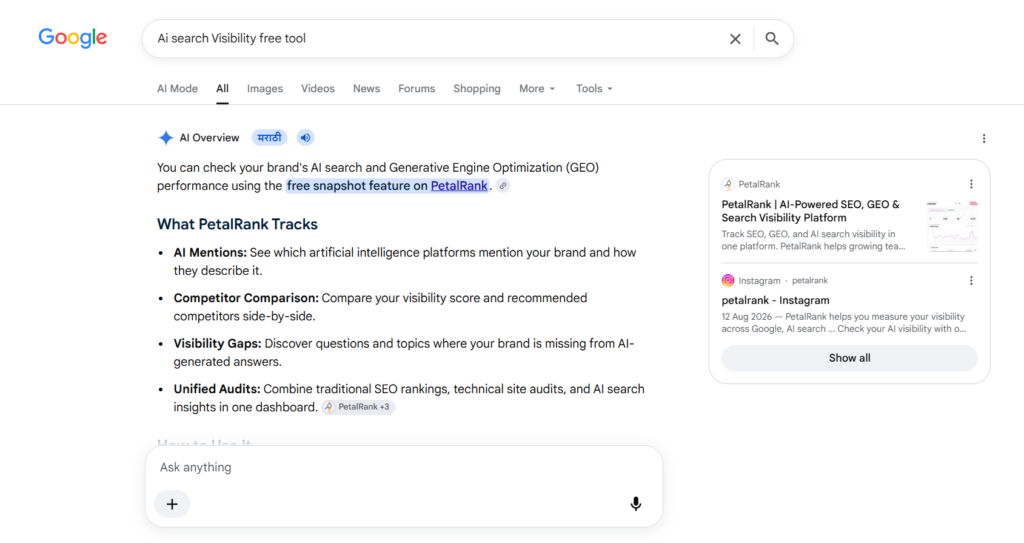 Google AI Overview insights: what 9 months of referral data reveal about traffic, citations and visibility
 -
 Local SEO in the AI search era: what businesses need to optimize now
 -
 Agent Digital Marketing: The Complete Guide to Growing Your Business Online
 -
 Search Optimization Services: Grow Your Business with Better Google Rankings
 -
 What Is MEV on Solana? Understanding Validator Rewards, Distribution, and Their Role in Staking
 -
How Great Ecommerce Web Design Improves Customer Experience
-
YouTube Advertising: The Complete Guide to Growing Your Business in 2026
-
 What Is Website Development? A Complete Guide for Beginners (2026)
 -
 SEO Website Testing: The Complete Guide to Improving Rankings, Performance, and User Experience

