
How to Increase Click-Through Rate
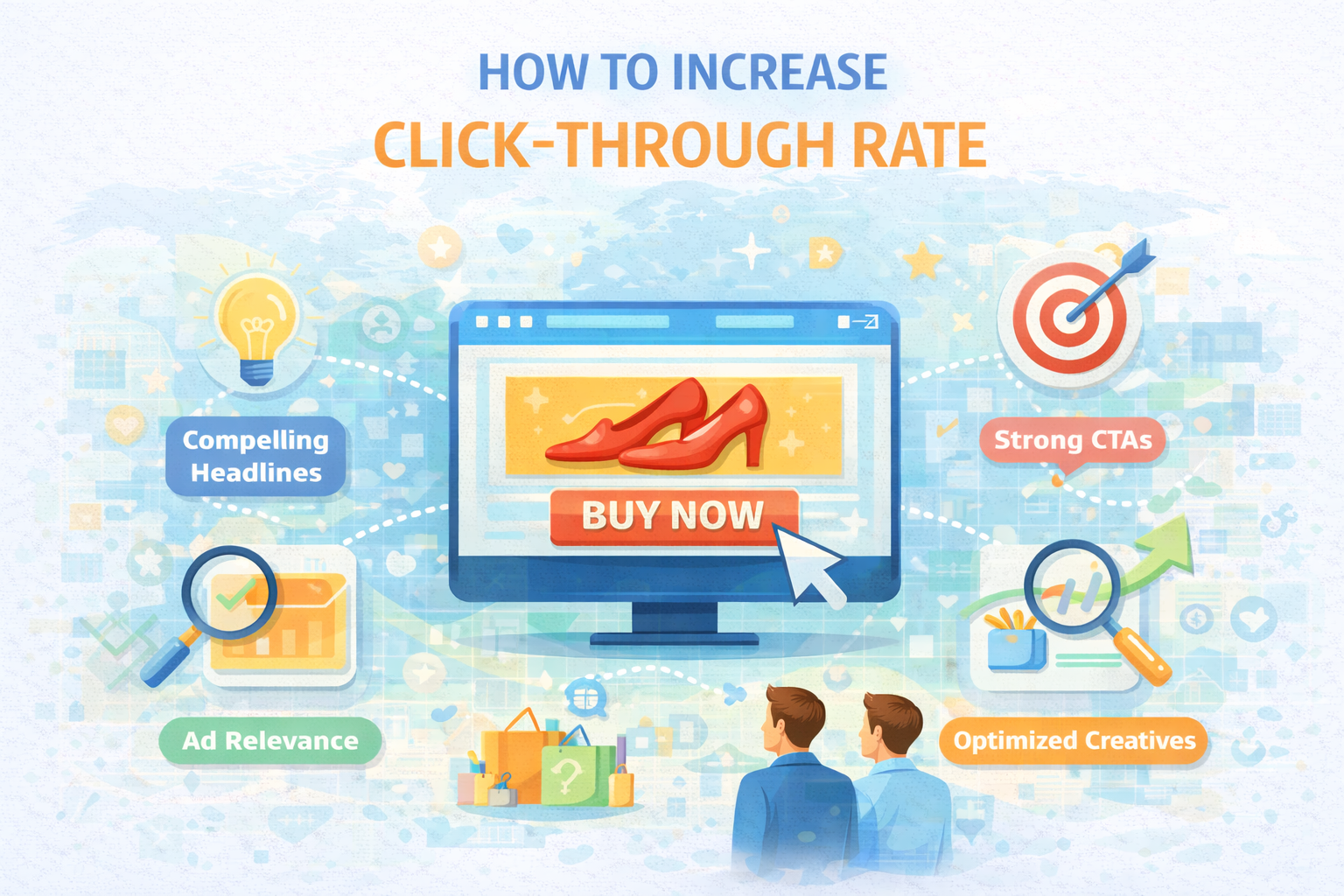
Click-through rate (CTR) is one of the clearest indicators of how well your marketing messages are resonating with your audience. Whether it’s an email, a search ad, a social post, or a display banner, CTR tells you how many people were enticed enough by your headline, description, or creative to take action and click.
But increasing CTR isn’t just a vanity metric exercise. Higher CTR often leads to better engagement, stronger conversion pipelines, and lower cost per acquisition across paid and organic channels.
In this guide, we’ll explore what CTR really is, why it matters, how it’s calculated, what good benchmarks look like, and — most importantly — actionable strategies to improve it across your marketing ecosystem.
What Is Click-Through Rate (CTR)?
Click-through rate measures the percentage of people who see your content — such as an ad, email, or search result — and then click through to interact with it.
CTR is a ratio of engagement rather than volume. It reflects the effectiveness of your message in capturing attention and driving interest at the moment of exposure.
For marketers, CTR is a barometer of creative resonance, relevance to audience intent, and clarity of call-to-action. If your CTR is low, it signals a disconnect between what your audience expects and what your content delivers.
Why CTR Matters in Digital Marketing
CTR matters because it sits at the intersection of visibility and action. A high click-through rate suggests that:
- Your audience understands and likes your offer
- Your messaging matches intent and context
- Your creative stops the scroll long enough to provoke interest
- Search engines and platforms view your content as relevant
In paid advertising, a higher CTR often improves quality scores, which can lower cost per click and improve positioning. In email marketing, CTR shows how effectively your subject line and content pique interest. On organic search listings, strong CTR signals relevance to search engines, which can boost rankings over time.
In short, CTR impacts performance, efficiency, and long-term growth.
How Click-Through Rate Is Calculated
CTR is a simple percentage, but its interpretation depends on context:
CTR = (Clicks ÷ Impressions) × 100
For example, if an ad gets 5 clicks from 200 impressions, its CTR is:
(5 ÷ 200) × 100 = 2.5%
That means 2.5% of the people who saw the content clicked it.
Interpreting CTR requires understanding industry, channel, and audience expectations — a “good” CTR in one environment may be average in another.
Average CTR by Channel: What to Expect
CTR benchmarks vary widely depending on medium and industry. Some general tendencies include:
Search Ads
Search ads typically have higher CTR because they match user intent directly, especially for transactional queries. When your ad meets a specific search need, people are more likely to click.
Social Ads
Social CTR tends to be lower than search because users are passively browsing rather than actively searching. Creative relevance and audience targeting play a bigger role here.
Email Marketing
Email CTR varies based on list quality, offer relevance, and timing. Strong segmentation and personalization often lift email CTR significantly.
Display Advertising
Display banner CTRs are generally lower due to the wide audience and indirect intent. Here, impression value and upper-funnel engagement matter more.
Rather than fixate on exact percentages, focus on trends and improvements over time relative to your historical data.
Proven Ways to Increase Click-Through Rate
1. Refine Your Headlines and Subject Lines
Your headline or subject line is the first thing people see. Make it compelling by focusing on value, curiosity, and clarity. Use power words and benefits that resonate with your audience’s goals.
2. Align Messaging With Audience Intent
Ensure that your copy reflects what your audience is actually looking for at that moment. In search ads, match keyword intent. In social ads, align with audience interests and behaviors.
3. Add Clear, Action-Oriented CTAs
A strong call-to-action bridges the gap between interest and click. Use verbs that lead with action and clarify what users will get — “Get Your Free Guide,” “See Pricing,” “Start Saving Today.”
4. Use Dynamic Creative Elements
In environments like paid social or display, use dynamic creatives that adjust visuals and copy to audiences in real time. Personalized creative — such as featuring products users browsed — improves relevance and CTR.
5. Leverage Segmentation and Personalization
Generic messaging rarely drives attention. Segment your audience and tailor messages to each group’s preferences, behaviors, or lifecycle stage. Personalized emails and ads consistently outperform broad messaging.
6. Improve Visual Appeal
On visual platforms, aesthetics matter. Use clean design, bold imagery, strong contrasts, and attention-grabbing visuals that support your message rather than distract from it.
7. Test and Iterate Continuously
Never settle on one version of your creative. A/B test headlines, CTAs, visuals, and audience segments. Use data from tests to guide iterative improvements.
Common Mistakes That Hurt CTR
Ignoring Audience Signals
Casting a wide net without understanding intent dilutes relevance and lowers engagement.
Weak Calls to Action
Vague CTAs like “Learn More” lack urgency and specificity, which reduces click interest.
Overly Long Copy
Cluttered, verbose messaging makes it hard for users to quickly understand your offer.
Poor Visual-Copy Alignment
Images that don’t support or clarify your message confuse audiences and reduce CTR.
Not Testing Across Channels
What works in email may not work on social or search. Tailor content to each environment and test accordingly.
Avoiding these pitfalls helps you maintain momentum while improving performance.
Tools to Track and Improve Click-Through Rate
Several tools help marketers monitor and optimize CTR across channels:
✔ Analytics Platforms (Google Analytics, Adobe Analytics) for performance trends
✔ Ad Platform Dashboards (Facebook, Google Ads) for channel-specific CTR data
✔ Email Marketing Platforms (Mailchimp, HubSpot) for detailed email engagement metrics
✔ A/B Testing Tools (Optimizely, VWO) for experimentation
✔ Heatmaps & Session Recording (Hotjar, Crazy Egg) to understand user attention patterns
Using these tools in combination gives you both macro and micro insights to pinpoint what drives clicks — and what doesn’t.
Final Thoughts: CTR as a Performance Lever
Click-through rate is not just a metric — it’s a signal. It tells you whether your messaging resonates, whether your offer aligns with audience intent, and whether your creative earns attention.
By understanding CTR, benchmarking it appropriately, and taking deliberate steps to refine your messaging and targeting, you can significantly boost engagement and downstream conversions.
Improving CTR doesn’t require magic — just clarity, relevance, and persistent optimization.
Recent posts
-
 Best AI Tools in 2026: Which Ones Are Actually Worth Using?
 -
 Google AI Overview insights: what 9 months of referral data reveal about traffic, citations and visibility
 -
 Local SEO in the AI search era: what businesses need to optimize now
 -
 Agent Digital Marketing: The Complete Guide to Growing Your Business Online
 -
 Search Optimization Services: Grow Your Business with Better Google Rankings
 -
 What Is MEV on Solana? Understanding Validator Rewards, Distribution, and Their Role in Staking
 -
How Great Ecommerce Web Design Improves Customer Experience
-
YouTube Advertising: The Complete Guide to Growing Your Business in 2026
-
 What Is Website Development? A Complete Guide for Beginners (2026)
 -
 SEO Website Testing: The Complete Guide to Improving Rankings, Performance, and User Experience

