
May 2026 Google Core Update: Recovery Guide, AI SEO & GEO Strategy
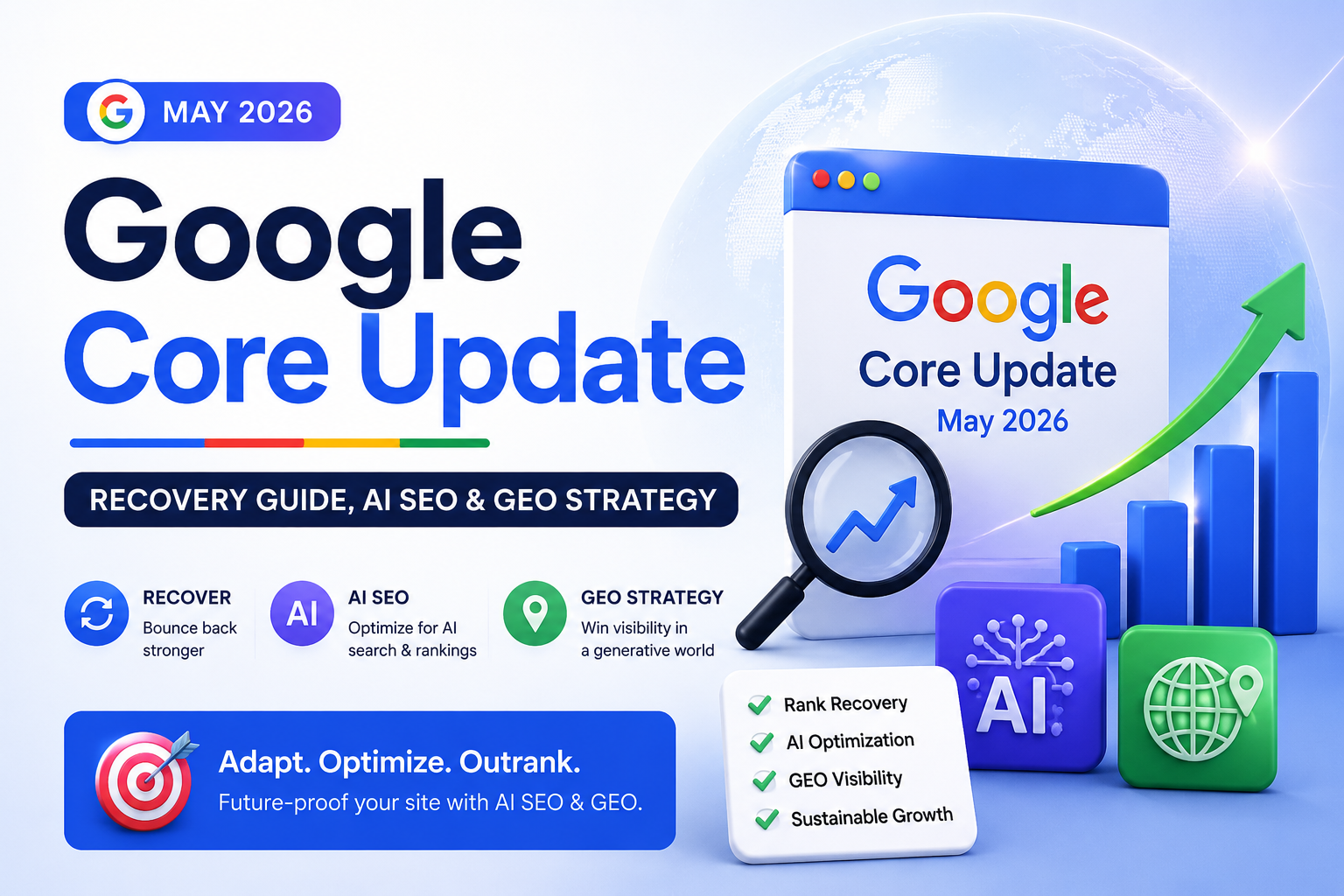
May 2026 Google Core Update: What your business needs to know (And why this update is bigger than rankings)
Google didn’t just update its algorithm.
It updated the rules of online visibility.
And if your website traffic suddenly dropped after May 21, you’re probably asking the same question thousands of business owners are asking right now:
“What happened?”
Imagine spending months creating content, improving rankings, and growing organic traffic, only to wake up one morning and discover that some of your best-performing pages have slipped.
That’s exactly what many businesses are experiencing after the May 2026 Google Core Update.
But here’s the thing.
This update isn’t really about rankings.
It’s about relevance.
It’s about trust.
And increasingly, it’s about whether Google and AI systems believe your content deserves to be the answer.
Most businesses are treating this as another Google update.
We believe it’s much bigger than that.
The May 2026 Google algorithm update is part of a broader shift toward AI-powered search, where customers are no longer simply clicking links. They’re asking questions and receiving answers from Google AI Overviews, ChatGPT, Gemini, Perplexity, and Google’s emerging AI search experiences.
And in that world, ranking is only part of the equation.
Being recommended is what matters.
In this guide, we’ll break down what changed in the Google Core Update May 2026, which websites were affected, why traffic is dropping, how to recover from Google Core Update 2026, and what businesses should do to remain visible in both traditional search and AI-driven search experiences.
Quick summary: May 2026 Google Core Update
If you’re short on time, here’s what you need to know.
The May 2026 Google Core Update appears to reinforce several key priorities:
* Stronger focus on search intent matching
* Greater emphasis on expertise and trust signals
* Increased scrutiny of thin and generic AI-generated content
* More value placed on original insights and first-hand experience
* Continued importance of topical authority
* Better evaluation of user satisfaction signals
* Growing alignment between traditional search and AI-powered search
What we’re seeing so far after the May 2026 Core Update
While the rollout is still underway, early signs suggest this is not a minor update.
Across the SEO community, businesses are already reporting significant fluctuations in rankings and traffic.
Discussions across industry forums and SEO communities suggest the update is causing meaningful volatility across industries, though the impact appears to vary significantly from website to website.
What’s particularly interesting is the level of uncertainty. Many businesses are still trying to understand whether the changes they’re seeing are temporary fluctuations or longer-term ranking shifts.
SEO tracking tools, including Semrush, Sistrix, Similarweb, Accuranker, Advanced Web Ranking, and other industry monitoring platforms, have reported elevated volatility since the rollout began.
Businesses should remember that the May 2026 Google Core Update is still rolling out. Google has stated that the rollout may take up to two weeks to complete, meaning ranking movements observed today may look very different once the update fully settles.
The worst mistake is making drastic changes before the rollout finishes.
Espial Observation: The biggest winners we’re seeing after the May 2026 Core Update aren’t necessarily publishing more content. They’re publishing more useful content while strengthening their visibility across AI platforms such as Google AI Overviews, ChatGPT Search, Gemini, and Perplexity.
The biggest takeaway?
Businesses should stop thinking only about rankings and start thinking about becoming the most trusted source in their category.
That approach works across Google Search, Google AI Overviews, ChatGPT, Gemini, and Perplexity.
What the SEO community is reporting
While the rollout is still underway, SEO professionals and website owners across industries are reporting increased volatility levels.
Discussions across industry forums, SEO communities, and visibility tracking platforms suggest that rankings continue to fluctuate as Google rolls out the update.
Multiple SEO monitoring tools, including Semrush, Sistrix, Similarweb, Accuranker, Mozcast, and DataForSEO, have reported increased volatility since the update began.
The key takeaway is simple:
Avoid making major SEO changes until the rollout is complete.
Google has indicated that the rollout may take up to two weeks, meaning ranking positions and traffic patterns may continue to shift before the update fully settles.
Businesses that focus on long-term quality improvements typically make better decisions than those reacting to day-to-day fluctuations.
What most businesses are getting wrong about the May 2026 Core Update
At Espial Solutions, we believe many businesses are misreading this update.
They’re treating it as a content update.
We see it as a visibility update.
That’s an important distinction.
Most recovery conversations still focus on rankings, keywords, and traffic.
Those metrics matter.
But they’re no longer the complete picture.
Google isn’t simply evaluating pages anymore.
It’s evaluating sources.
It’s about determining which businesses, brands, websites, and experts deserve to be trusted.
The brands that win over the next three years won’t necessarily publish the most content.
They’ll become the most trusted source of answers across search engines and AI systems.
That’s why the May 2026 Core Update matters far beyond traditional SEO.
What changed in the Google Core Update May 2026?
The May 2026 Google algorithm update officially began rolling out on May 21, 2026.
Like previous broad core updates, this isn’t a penalty update.
Google isn’t targeting a single tactic, industry, or type of website.
Instead, it’s reassessing which pages deserve visibility. As with previous broad core updates, Google has not announced a specific ranking factor change. Instead, the update appears focused on improving how Google’s systems evaluate content quality, relevance, expertise, and overall usefulness.
From what we’re seeing, three major themes stand out.
Search intent matters more than ever
Think about someone searching for “best CRM software.”
Ten years ago, Google primarily looked for pages optimized around those keywords.
Today, Google is trying to understand the actual problem behind the search.
Is the user a startup founder?
An enterprise buyer?
A sales manager looking for integrations?
Someone comparing pricing?
Someone switching from another platform?
A page that simply targets the keyword may struggle.
A page that solves the underlying problem is far more likely to win.
That’s exactly where we’re seeing movement after the May 2026 Google Core Update.
Google is becoming increasingly effective at understanding not just what people search, but why they search.
Expertise is becoming a competitive advantage.
The internet has more content than ever before.
Google knows that.
What it wants now is evidence that the person writing the content actually knows what they’re talking about.
Real-world experience.
Expert opinions.
Original insights.
First-hand knowledge.
The businesses gaining visibility are increasingly the ones demonstrating genuine expertise rather than simply summarizing what already exists online.
Content created for algorithms is losing ground.
For years, SEO was often treated as a numbers game.
More pages.
More keywords.
More content.
Today, that approach is becoming less effective.
Google appears to be rewarding content that helps users and reducing visibility for content created primarily to rank.
That’s a significant shift for businesses still relying on volume-based content strategies.
What websites were affected by the May 2026 Core Update?
Not every industry has experienced the same level of volatility.
Several patterns are already emerging.
Websites with thin content
Imagine two online stores selling the same running shoe.
Store A copies the manufacturer’s product description.
Store B adds sizing guidance, customer FAQs, comparisons, usage recommendations, expert insights, and buying advice.
Both target the same keyword.
Both sell the same product.
But only one genuinely helps the customer make a decision.
The May 2026 Google Core Update appears to be rewarding the second approach.
Google is increasingly asking:
“Which page is actually useful?”
Not:
“Which page used the keyword most often?”
YMYL websites
Health, finance, insurance, legal, and medical websites continue to face heightened scrutiny.
When content can influence important life decisions, Google expects stronger evidence of expertise and trustworthiness.
eCommerce businesses
Many eCommerce websites continue to struggle with:
* Duplicate product descriptions
* Thin category pages
* Weak informational content
* Poor mobile experiences
The brands winning today are investing heavily in education, comparisons, buying guides, and customer-focused content.
SaaS and B2B companies
Many SaaS brands have actually benefited from this update.
Why?
Because they invested in thought leadership.
They built topic clusters.
They published in-depth content based on industry expertise.
Why did my website traffic drop after the May 2026 update?
This is probably the most common question businesses are asking right now.
The answer may surprise you.
Your website was probably not penalized.
Instead, Google reassessed which pages best satisfy user needs.
Think of it like a restaurant review platform updating its ratings.
Your restaurant didn’t suddenly become bad overnight.
Others simply became more relevant, more useful, or more trusted.
Common reasons businesses are losing visibility include:
* Content lacking depth
* Weak expertise signals
* Outdated information
* Poor intent alignment
* Weak topical authority
* Slow website performance
* Generic AI-generated content
* Better-performing competitors
In many cases, rankings aren’t falling because your website got worse.
They’re falling because someone else got better.
Does AI-generated content rank after the Google Core Update?
This is one of the biggest misconceptions in SEO right now.
Many businesses assume Google is penalizing AI content.
That’s not what we’re seeing.
Google has consistently said it evaluates content quality, not how the content was created.
AI isn’t the problem.
Poor content is.
Let’s imagine two SaaS companies.
Company A publishes 200 AI-generated articles in six months.
Company B publishes 20 expert-led articles based on real customer conversations, industry experience, and original insights.
On paper, Company A appears to have an advantage.
More content.
More pages.
More keywords.
But Google’s goal isn’t to reward volume.
It’s to reward value.
The May 2026 Core Update appears to reinforce exactly that.
Twenty genuinely useful articles often outperform hundreds of generic ones.
The future belongs to businesses using AI as a tool, not a replacement for expertise.
How does Google evaluate helpful content in 2026?
Google’s definition of helpful content continues to evolve, but several themes remain consistent.
Experience
Has the author actually done what they’re writing about?
Expertise
Do they understand the subject deeply?
Authoritativeness
Are they recognized as a credible source?
Trustworthiness
Can users trust the information being presented?
Beyond E-E-A-T, Google also evaluates:
* Original insights
* User satisfaction
* Content depth
* Technical accessibility
* Topical authority
* Overall site experience
The days of publishing hundreds of generic articles and expecting rankings are fading quickly.
Why this update matters for AI search
Most businesses are still looking at this update through a traditional SEO lens.
That’s understandable.
But it’s also risky.
Because the search itself is changing.
A few years ago, someone searching for a marketing agency would type:
“Best digital marketing agency.”
They would browse websites, compare options, and eventually make a decision.
Today, they might ask:
“Which agency specializes in AI SEO and GEO for B2B companies?”
ChatGPT answers.
Gemini answers.
Perplexity answers.
Google AI Mode answers.
And often those answers are generated before a user ever visits a website.
That changes everything.
Visibility is no longer just about rankings.
It’s about recommendations.
The businesses gaining visibility from AI-generated answers are positioning themselves for where search is heading.
Businesses focused only on rankings risk optimizing for yesterday’s internet.
The biggest shift nobody is talking about
Most discussions around the May 2026 Google Core Update focus on rankings.
We believe that’s only part of the story.
The bigger shift is happening in how users discover information.
Google is expanding AI-powered search experiences.
Users are increasingly turning to ChatGPT Search, Gemini, Perplexity, Google AI Overviews, and Google’s AI Mode for answers.
That means businesses now face two visibility challenges:
- Ranking in search results.
- Being cited in AI-generated answers.
Historically, ranking was enough.
Increasingly, it isn’t.
The brands that dominate the next phase of digital marketing will be the ones that build authority across both traditional search engines and AI-powered discovery platforms.
That’s why SEO and GEO are no longer separate conversations.
They’re becoming part of the same strategy.
The new visibility equation
For years, digital marketing followed a simple formula:
Search → Website → Lead
A user searched.
They clicked on a website.
They became a lead.
Today, the journey is changing.
Increasingly, it looks like this:
Search → AI Answer → Website → Lead
And in some cases:
Search → AI Answer → Lead
Someone asks ChatGPT.
Someone asks Gemini.
Someone asks Perplexity.
Someone uses Google AI Overviews or Google’s AI Mode.
The platform provides an answer before the user ever visits a website.
If your business isn’t included in that answer, you may never enter the buying journey.
This is why AI visibility is becoming just as important as traditional search visibility.
The businesses adapting now are positioning themselves for the future of discovery.
Why GEO services for AI search are becoming essential
Businesses should now monitor visibility across multiple discovery ecosystems, including Google Search, Google AI Overviews, Google AI Mode, ChatGPT Search, Gemini, and Perplexity.
Search visibility alone no longer provides the full picture.
The brands that will earn the most visibility in the coming years will be those that build authority across both traditional search engines and AI-powered answer engines.
Whether it’s ChatGPT, Gemini, Perplexity, Google AI Overviews, or Google’s AI Mode, users are increasingly receiving answers instead of lists of links.
Imagine someone asking:
“What is the best AI SEO agency for B2B companies?”
The AI system doesn’t show ten blue links.
It recommends a handful of brands it trusts.
If your business isn’t part of those recommendations, you’re invisible to that search.
That’s why GEO services for AI search are becoming essential.
Generative Engine Optimization helps businesses:
* Improve AI visibility
* Earn citations in AI-generated answers
* Strengthen brand authority
* Improve entity recognition
* Increase recommendation frequency
* Build trust across AI ecosystems
The question businesses should be asking today isn’t:
“Do I rank?”
It’s:
“Does AI know I exist?”
Increasingly, that’s becoming one of the most important questions in digital marketing.
Why AI SEO services are becoming critical
Traditional SEO helps your website rank.
AI SEO helps your business become discoverable wherever users search.
That includes:
* Google Search
* Google AI Overviews
* ChatGPT
* Gemini
* Perplexity
* Future AI search experiences
As search evolves, businesses need visibility across both traditional search engines and AI-generated answer engines.
This is why AI SEO services are becoming one of the fastest-growing areas of digital marketing.
How to recover from Google Core Update 2026
Recovery is possible.
But recovery requires a process.
One mistake we see after every Google Core Update is panic.
Businesses immediately start rewriting content, changing titles, deleting pages, and making random adjustments.
Imagine a doctor prescribing treatment before running a diagnosis.
That would make no sense.
The same applies to SEO.
Before making changes, identify:
* Which pages lost visibility
* Which keywords declined
* Which competitors gained ground
* Which search intents changed
Businesses that wait for the rollout to complete before making major changes typically make better decisions than those reacting to daily ranking fluctuations.
Why some businesses are panicking, and others are preparing
Every Google Core Update creates two groups.
The first group watches the rankings every hour.
The second group studies what Google is rewarding.
The first group reacts.
The second group adapts.
That’s why some businesses recover quickly while others spend months chasing traffic losses.
The May 2026 Core Update appears to be rewarding businesses that have invested in:
- Genuine expertise
- Original insights
- Strong topical authority
- Helpful content
- Trust signals
- AI-era visibility strategies
The lesson isn’t to panic.
The lesson is to evolve.
The Espial Recovery Framework™
Phase 1: Diagnose
Identify:
* Traffic losses
* Ranking declines
* Content gaps
* Competitor gains
* Intent mismatches
Phase 2: Strengthen
Focus on:
* E-E-A-T improvements
* Content quality
* Expert authorship
* Topic clusters
* Technical SEO
* User experience
Phase 3: Future-proof
Prepare for where search is heading.
This means:
* GEO implementation
* AI visibility optimization
* Entity SEO
* AI citation tracking
* Brand authority building
The goal isn’t simply recovering rankings.
It’s building visibility that survives future updates.
10-point recovery checklist after the May 2026 Google algorithm update
✓ Audit declining pages
✓ Refresh outdated content
✓ Add expert authorship
✓ Improve trust signals
✓ Strengthen E-E-A-T
✓ Improve page speed
✓ Fix technical SEO issues
✓ Build topic clusters
✓ Optimize for AI Overviews
✓ Implement a GEO strategy
Businesses that consistently focus on these fundamentals typically recover faster than those searching for shortcuts.
Looking for an SEO agency for Google Core Update recovery?
If your rankings dropped after the May 2026 Google algorithm update, the worst thing you can do is panic.
Many businesses immediately start rewriting pages, changing URLs, deleting content, or chasing quick SEO fixes.
In reality, successful recovery requires a structured approach that combines technical SEO, content strategy, E-E-A-T improvements, topical authority building, AI SEO services, and GEO services for AI search.
At Espial Solutions, we help businesses diagnose ranking losses, identify content gaps, improve search intent alignment, strengthen authority signals, and build recovery roadmaps designed for both traditional search engines and AI-powered discovery platforms.
Whether you’re recovering from the May 2026 Google Core Update or preparing for future updates, the goal isn’t simply to regain rankings.
It’s to build sustainable visibility.
Frequently asked questions
What changed in the Google Core Update May 2026?
The update strengthened Google’s focus on expertise, trustworthiness, intent matching, topical authority, originality, and content usefulness.
How to recover from Google Core Update 2026?
Start with a content and SEO audit, improve E-E-A-T signals, strengthen topical authority, enhance user experience, and implement a strategy that combines SEO and GEO.
Why did my website traffic drop after the May 2026 update?
Most traffic declines occur because Google reassessed which pages best satisfy user intent. This is generally a re-evaluation rather than a penalty.
Does AI-generated content rank after the Google Core Update?
Yes. High-quality AI-assisted content can rank well when combined with human expertise, original insights, and editorial oversight.
How does Google evaluate helpful content in 2026?
Google evaluates content using E-E-A-T signals, originality, usefulness, user satisfaction, topical authority, technical accessibility, and overall trustworthiness.
What websites were affected by the May 2026 Core Update?
Websites with thin content, weak expertise signals, duplicate content, poor user experience, and generic AI-generated content appear to have experienced the most volatility.
What is GEO and why does it matter after the May 2026 update?
GEO, or Generative Engine Optimization, helps businesses appear in AI-generated answers across ChatGPT, Gemini, Perplexity, and Google AI search experiences.
What are AI SEO services?
AI SEO services combine traditional SEO with AI visibility optimization, helping businesses become discoverable across both search engines and AI platforms.
The real message behind the May 2026 Core Update
Most businesses are treating this as another algorithm update.
We believe it’s something much bigger.
The May 2026 Google Core Update is Google’s clearest signal yet that search is evolving beyond rankings.
Visibility is increasingly determined by whether your business is trusted enough to become part of the answer.
That means building expertise.
Creating original insights.
Strengthening authority.
And ensuring your brand can be discovered not only by search engines but also by AI systems.
The businesses that adapt to this shift will gain market share.
The businesses that don’t may find themselves becoming increasingly invisible.
How Espial Solutions can help
If AI doesn’t mention your brand, future customers may never discover it.
That’s the reality businesses are beginning to face.
The May 2026 Google Core Update isn’t just another algorithm adjustment.
It’s another signal that search is becoming AI-driven.
At Espial Solutions, we help businesses improve visibility across:
* Google Search
* Google AI Overviews
* ChatGPT
* Gemini
* Perplexity
* Emerging AI discovery platforms
Using our proprietary PetalRank framework, we identify where your brand appears, where competitors are outperforming you, and what opportunities exist to improve both search rankings and AI citations.
The goal isn’t simply to rank.
The goal is to become the answer.
In AI-driven search, the brands that get recommended are increasingly the ones that get chosen.
Because if AI doesn’t mention your brand, future customers may never discover it.
Espial Solutions is a Pune-based AI-powered digital marketing agency helping startups, SMEs, and enterprises improve visibility across search engines, AI platforms, and emerging discovery channels through AI SEO, GEO, performance marketing, and digital growth strategies.
Recent posts
-
 Best AI Tools in 2026: Which Ones Are Actually Worth Using?
 -
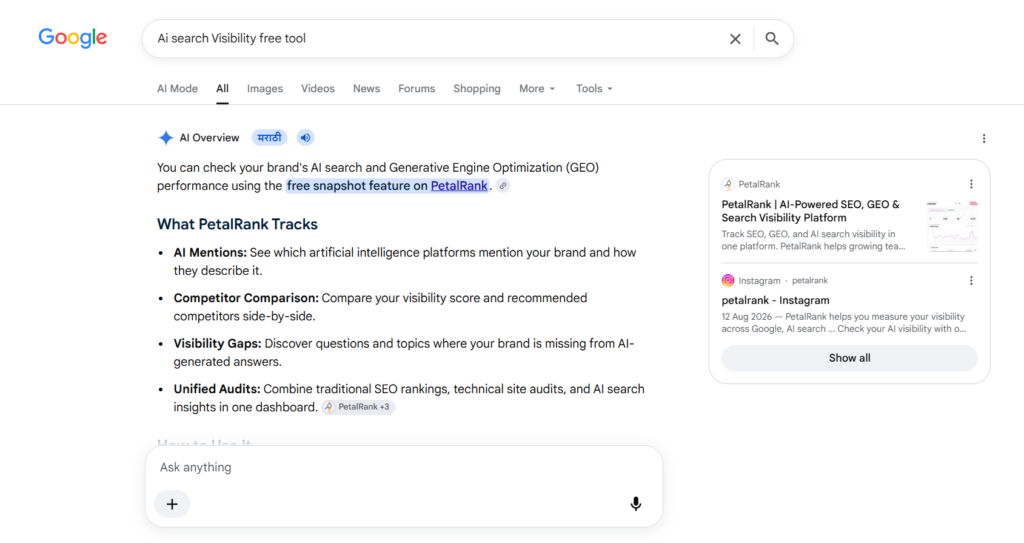 Google AI Overview insights: what 9 months of referral data reveal about traffic, citations and visibility
 -
 Local SEO in the AI search era: what businesses need to optimize now
 -
 Agent Digital Marketing: The Complete Guide to Growing Your Business Online
 -
 Search Optimization Services: Grow Your Business with Better Google Rankings
 -
 What Is MEV on Solana? Understanding Validator Rewards, Distribution, and Their Role in Staking
 -
How Great Ecommerce Web Design Improves Customer Experience
-
YouTube Advertising: The Complete Guide to Growing Your Business in 2026
-
 What Is Website Development? A Complete Guide for Beginners (2026)
 -
 SEO Website Testing: The Complete Guide to Improving Rankings, Performance, and User Experience

