
How D2C Helps Brands Scale Faster
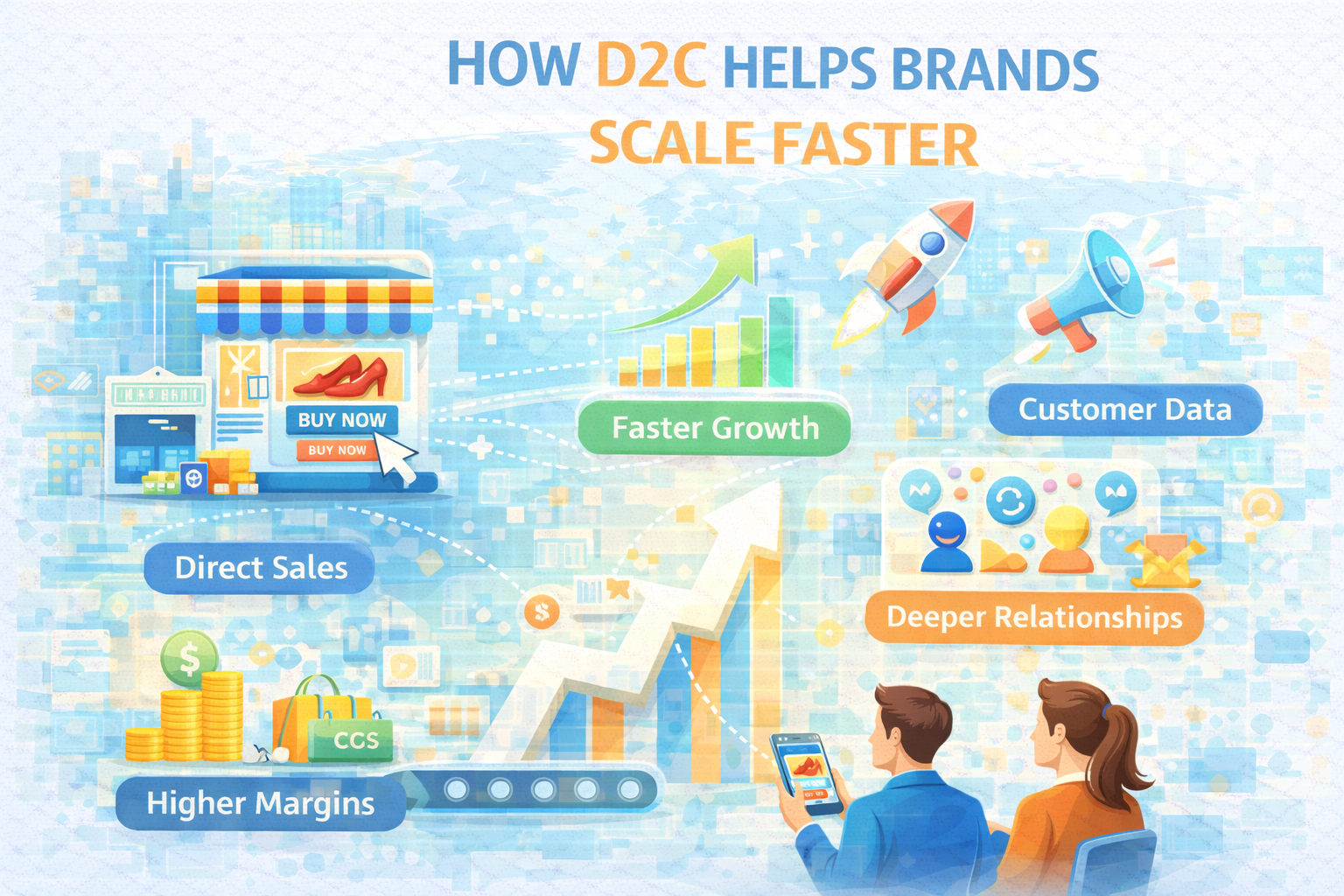
Direct-to-consumer (D2C) has transformed how brands grow in the digital age. Instead of relying solely on traditional wholesale, retail partners, or middlemen, brands that adopt a D2C model sell directly to their customer base — owning the relationship, the data, and the experience.
This shift unlocks new opportunities for growth, agility, and scale. Today, brands of all sizes use D2C strategies to build stronger connections with customers, drive repeat purchases, and accelerate revenue growth faster than traditional distribution models allow.
In this guide, we’ll explore what D2C is, why it matters, and how it empowers brands to scale more quickly in competitive markets.
What Is D2C (Direct-to-Consumer)?
Direct-to-consumer (D2C) is a business model in which brands sell products directly to end customers, bypassing traditional intermediaries like wholesalers and retail stores. Instead of relying on physical shelf space controlled by retailers, D2C brands cultivate their own distribution channels — usually through ecommerce platforms, social media, marketplaces, or mobile apps.
This model gives brands full control over pricing, messaging, customer experience, and the data generated from every interaction. By owning the entire journey from awareness to purchase, D2C companies build deeper customer relationships and create opportunities for repeat engagement.
Why D2C Matters in Today’s Market
The rise of the internet, social media, and ecommerce has fundamentally changed how people discover and buy products. Consumers now expect seamless online shopping experiences tailored to their preferences, and they value authenticity and direct engagement with brands.
D2C matters because it:
- Eliminates reliance on middlemen
- Reduces dependency on retail partners
- Improves margins by cutting out the retail markup
- Gives brands direct access to customer data
- Enables personalized marketing and engagement
In a world where brand loyalty is earned through experience rather than physical presence alone, D2C provides the infrastructure to build and sustain that loyalty.
How D2C Enables Faster Scaling
Ownership of Customer Data
One of the biggest advantages of the D2C model is direct access to customer data. When brands sell directly, every interaction — from clicks to purchases to repeat behavior — becomes an insight.
With this data, marketers can understand who their customers are, what they care about, and how they behave. This enables more effective targeting, personalization, and optimization of product offerings in real time.
Instead of buying generic third-party data that only provides surface insights, brands can make strategic decisions based on their own audience patterns.
Agile Marketing and Messaging
Unlike traditional distribution channels, where messaging must be approved by retailers and constrained by shelf space, D2C brands have complete control over their narrative.
This allows for rapid testing and iteration of marketing campaigns. A brand can try new messaging one week, test offers the next, and pivot quickly based on performance without waiting for external approval.
This agility accelerates growth because it reduces the time between insight, implementation, and outcome.
Higher Margins and Pricing Flexibility
D2C eliminates intermediary costs — wholesalers, distributors, and retail markup — which improves gross margins. Higher margins give brands the flexibility to reinvest more into customer acquisition, fulfillment, and customer experience.
Because brands can set their own pricing and promotional strategies, they can optimize offers according to profitability rather than retailer constraints.
This financial flexibility fuels faster scaling by providing resources to invest in customer retention and acquisition.
Personalized Customer Experience
When brands sell directly, they control every touchpoint — from product discovery to post-purchase support. This enables personalized experiences that foster loyalty.
Personalized recommendations, tailored email flows, customized offers, and seamless checkout experiences all contribute to stronger customer satisfaction. Satisfied customers are more likely to become repeat buyers and brand advocates, which helps sustain growth over time.
Efficient Customer Acquisition
Owning the customer journey enables D2C brands to better track and optimize acquisition channels. Whether through paid social, search campaigns, influencer partnerships, or email automation, D2C companies can pinpoint what works and double down quickly.
Instead of spreading budget thinly across channels with unknown returns, brands can focus on the strategies that deliver measurable results — a key advantage when scaling.
Examples of Brands That Scaled With D2C
Many well-known brands accelerated growth using the D2C model:
- Some started as niche ecommerce ventures and expanded into global markets because they could pivot quickly based on customer feedback.
- Others used social advertising and community building to create dedicated followings before launching new product lines.
- Some leveraged subscription models to drive recurring revenue and predictable growth.
These examples demonstrate how owning distribution and customer relationships unlocks strategic advantages that traditional retail models often lack.
Common Challenges in D2C and How to Overcome Them
While D2C offers many opportunities, it also presents challenges.
Customer Acquisition Costs (CAC)
Rising ad costs and competition can make customer acquisition expensive. The key is optimizing audience targeting and creative to improve relevance and reduce waste.
Logistics and Fulfillment
Managing warehousing, shipping, and returns can be complex. Many brands partner with fulfillment providers to scale efficiently.
Data Management
Collecting data is one thing; using it effectively is another. Successful D2C companies invest in analytics and customer platforms to turn insights into action.
Customer Retention
Once a customer purchases, retention becomes crucial. Loyalty programs, subscription offers, and post-purchase engagement help brands maintain momentum.
Overcoming these challenges requires strategy, experimentation, and a willingness to invest in systems that support long-term growth.
D2C Marketing Strategies That Drive Growth
To scale faster, many D2C brands use targeted marketing techniques such as:
- Personalized email campaigns that nurture repeat purchases
- Lookalike audiences on social platforms to expand reach
- Retargeting ads to convert engaged users
- Influencer collaborations to build credibility
- Content marketing that educates and entertains
These tactics help brands deepen engagement and turn casual browsers into loyal customers.
Measuring D2C Success
Success in D2C isn’t just revenue — it’s repeat business, customer lifetime value (CLV), acquisition efficiency, and brand advocacy.
Key metrics include:
- Customer acquisition cost (CAC)
- Customer lifetime value (CLV)
- Repeat purchase rate
- Average order value (AOV)
- Return on ad spend (ROAS)
Tracking these metrics helps brands understand which strategies fuel scalable growth and which need refinement.
The Role of Technology in D2C Growth
Modern ecommerce platforms, analytics tools, and marketing automation systems enable D2C brands to scale faster than ever. Technology supports:
- Data collection and segmentation
- Personalized messaging at scale
- Performance tracking in real time
- Automated workflows for customer nurturing
With the right tools, brands can focus on strategy and creativity rather than manual execution.
Why D2C Is More Relevant Than Ever
The digital landscape continues to evolve, and consumer expectations are rising. People want seamless online experiences, personalized offers, and direct engagement with brands.
D2C delivers on these expectations while giving brands the flexibility to innovate quickly. For businesses aiming to grow faster, reach customers more directly, and build lasting relationships, the D2C model is increasingly not just an option — but a strategic imperative.
Final Thoughts: Scaling With Purpose
Brand growth is not accidental; it’s strategic.
D2C helps brands scale faster by giving them control over customer experiences, data insights, pricing, and acquisition strategies — all under one roof.
When done thoughtfully, D2C empowers companies to understand their audience more deeply, respond to market shifts more quickly, and build meaningful connections that drive long-term loyalty and revenue.
In a world where personalization and speed matter, D2C is a competitive advantage brands can’t afford to ignore.
Recent posts
-
 Best AI Tools in 2026: Which Ones Are Actually Worth Using?
 -
 Google AI Overview insights: what 9 months of referral data reveal about traffic, citations and visibility
 -
 Local SEO in the AI search era: what businesses need to optimize now
 -
 Agent Digital Marketing: The Complete Guide to Growing Your Business Online
 -
 Search Optimization Services: Grow Your Business with Better Google Rankings
 -
 What Is MEV on Solana? Understanding Validator Rewards, Distribution, and Their Role in Staking
 -
How Great Ecommerce Web Design Improves Customer Experience
-
YouTube Advertising: The Complete Guide to Growing Your Business in 2026
-
 What Is Website Development? A Complete Guide for Beginners (2026)
 -
 SEO Website Testing: The Complete Guide to Improving Rankings, Performance, and User Experience

